
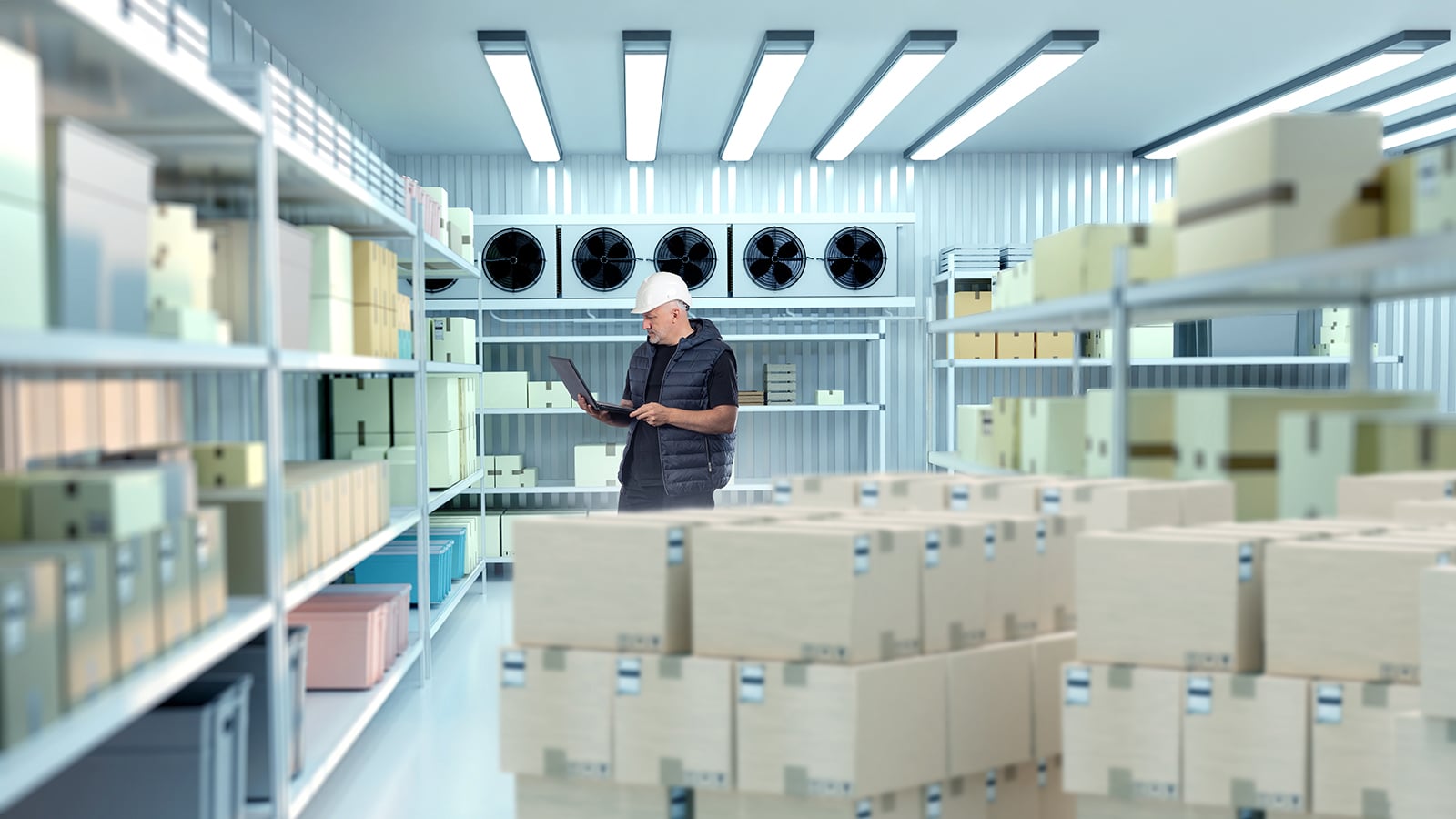
The U.S. cold-storage sector is working through a period of short-term disruption even as its longer-term demand story remains intact. Newmark’s 1H 2026 Cold Storage Market Overview reports that the industry recorded negative net absorption in the first six months of the year, underscoring a temporary mismatch between supply and demand.
Despite that near-term softness, the report cites several durable demand drivers: population growth, domestic food production, expanding e-grocery adoption and increasingly complex pharmaceutical and biologics supply chains. These fundamentals are expected to support ongoing utilization of temperature-controlled space even as the sector absorbs its current wave of deliveries.
Occupier behavior is contributing to a clear divide in performance. Tenants are increasingly gravitating toward modern, higher-quality cold-storage facilities, leaving older buildings at a disadvantage. Approximately 41 million cubic feet of new cold-storage capacity was delivered in the first half of 2026, while net absorption totaled 56 million cubic feet, resulting in a vacancy rate of 7.7%.
Newmark notes a bifurcated market between recently built product and legacy facilities. Assets delivered since 2020 have attracted stronger demand, while older properties have posted negative absorption since 2022. Those legacy buildings now account for 68% of total vacancy, compared with 24% for post-2020 space, highlighting a pronounced flight to quality within the cold-storage inventory.
Construction economics are another constraint. Newmark estimates that new cold-storage projects carry development costs ranging from $130 to $350 per square foot, alongside longer build times. Under those conditions, most new facilities are expected to take the form of build-to-suit, owner-user or pre-leased projects rather than speculative development.
By contrast, conversion costs for adapting older dry warehouses to cold storage are relatively lower, at an estimated $100 to $150 per square foot. Newmark suggests that this cost differential could encourage more repositioning of existing dry-warehouse space into temperature-controlled facilities.
Consumer dynamics are also in flux. While food-price inflation has moderated from its 2020–2022 peak, prices remain more than 30% above 2019 levels, according to Newmark. Households are contending with reduced SNAP benefits and higher gas prices since March 2026, putting additional pressure on food budgets.
Performance within grocery is uneven. Overall grocery unit sales fell 1.8% year over year, with fresh produce among the weakest categories. Frozen produce unit sales, however, rose by more than 5%, and broader frozen-food demand contributed to a modest year-over-year increase in total U.S. cold-storage inventories.
E-grocery trends are reinforcing this shift. Newmark reports that U.S. online grocery sales surged 21.5% year over year in July, while in-store grocery sales declined 2.6%. As more ordering moves toward delivery and home fulfillment, retailers are leaning on a mix of existing stores, third-party logistics providers and dedicated fulfillment centers, all of which rely heavily on cold-storage capacity.
On the healthcare side, Newmark points to strong growth in temperature-sensitive biologics, including GLP-1 therapies, with demand projected to grow at an 8.3% compound annual growth rate through 2033. Pharmaceutical products requiring cold storage now represent roughly 35% of pharmaceutical sales, up from 26% in 2017, and major logistics providers such as DHL, C.H. Robinson, FedEx and UPS are investing billions of dollars in specialized cold-chain infrastructure.
Newmark expects market conditions to improve in the second half of 2026 as inventories normalize and scheduled move-ins are completed, though vacancy is projected to hold near its long-term average. Overall, cold storage is described as being in a transition phase characterized by negative absorption, a pronounced quality split, consumer and macroeconomic headwinds, and evolving demand patterns across grocery, e-commerce and pharmaceuticals.