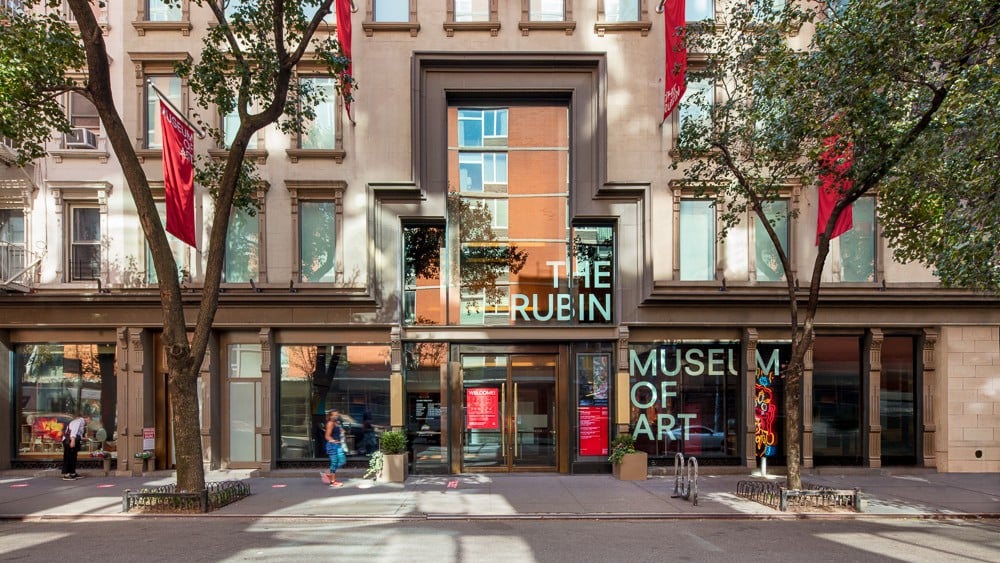
JLL has been engaged by the Rubin Museum of Himalayan Art to bring the institution’s New York City flagship property to market. The asset is located at 140–154 W. 17th St. in Chelsea and is being positioned as a rare opportunity to acquire and reposition a historically and architecturally significant mixed-use property.
According to JLL, the site sits at a key junction of several Manhattan neighborhoods, at the nexus of Chelsea, the Flatiron District and Greenwich Village. The location places the property within a dense, amenity-rich urban environment and within one of New York City’s most established cultural and commercial corridors.
The offering encompasses an approximately 80,000-square-foot mixed-use site. At its core is a six-story former museum building totaling roughly 52,000 square feet. This institutional-quality structure has historically housed the Rubin Museum of Himalayan Art and is described as having notable architectural character and robust infrastructure.
Adjacent to and contiguous with the former museum component is a residential element that includes 46 apartments. While specific unit mix and layouts were not disclosed, this component adds a multifamily dimension to the offering and contributes to the property’s overall mixed-use profile.
JLL is marketing the property as being suitable for a wide spectrum of potential future uses. In comments provided with the announcement, David Carlos, vice chairman and head of JLL’s Nonprofit, Education & Government Practice, characterized the asset as uniquely positioned within the New York City market. He emphasized its rich history, institutional-grade building systems and distinct architectural features as attributes that could support cultural, educational, commercial or broader mixed-use applications.
Carlos noted that opportunities to acquire properties capable of transitioning smoothly across multiple use types are uncommon in the current environment. In his view, the combination of location, physical scale, existing residential component and former institutional use differentiates this asset from typical offerings and underscores its potential for repositioning by a wide range of buyers.
No additional details about the marketing process, pricing guidance, targeted buyer profiles or anticipated transaction timeline were disclosed. Information regarding current occupancy, lease structures within the residential portion or any existing income streams associated with the property was also not provided. The announcement focuses primarily on the property’s scale, configuration and flexibility for adaptive use under future ownership.