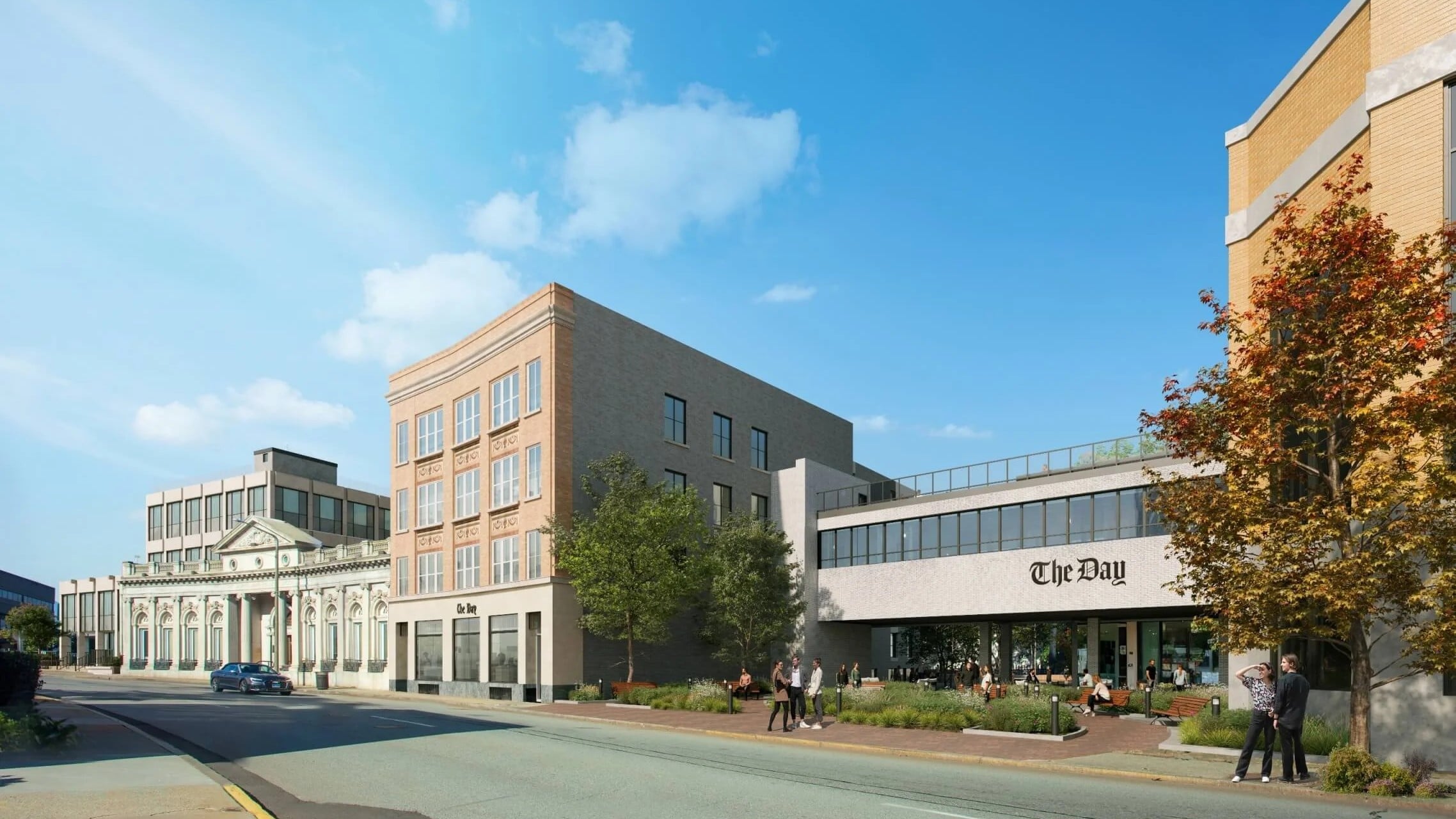
Eastern Bank has led a new construction-focused financing package for High Tide Capital LLC as the firm undertakes the adaptive reuse of The Day Building in downtown New London, CT. The bank is providing $16.9 million in construction-related funding to convert the former headquarters of The Day newspaper into a mixed-use residential and retail property. The project will deliver 68 market-rate apartments above approximately 2,100 square feet of ground-floor retail space.
The Day Complex consists of four historic structures located in the center of New London. The buildings sit immediately adjacent to key transportation and civic nodes, including the city’s Amtrak station, the regional ferry terminal with service to Long Island and nearby destinations, and the new Coast Guard Museum. The Day Building itself served as the newspaper’s home base for 140 years, anchoring local media operations for generations before its planned transition to residential use.
High Tide Capital’s principal, Max Patinkin, described the property as a central component of New London’s downtown urban renewal, emphasizing that the redevelopment will bring needed housing to a growing area of the city. The introduction of market-rate units in a walkable, transit-served location is intended to leverage the site’s proximity to regional transportation and cultural infrastructure while reusing an architecturally significant asset.
The project’s capital stack incorporates multiple public and private sources alongside Eastern Bank’s construction financing. The redevelopment has secured historic redevelopment approvals from both the National Park Service and the State Historic Preservation Office, enabling the use of historic tax incentives. The financing structure includes federal and state Historic Tax Credits, funding from the Connecticut Municipal Development Authority, and additional municipal incentives that support the repositioning of the complex.
By combining conventional bank construction financing with historic preservation tools and local development support, the High Tide Capital team is repositioning a long-standing newspaper facility into a multifamily-led mixed-use asset. The transaction illustrates how historic tax credit programs and municipal participation can be layered with private senior debt to facilitate adaptive reuse in a downtown setting, while retaining the character of a legacy property that has played a prominent role in New London’s civic and commercial history.