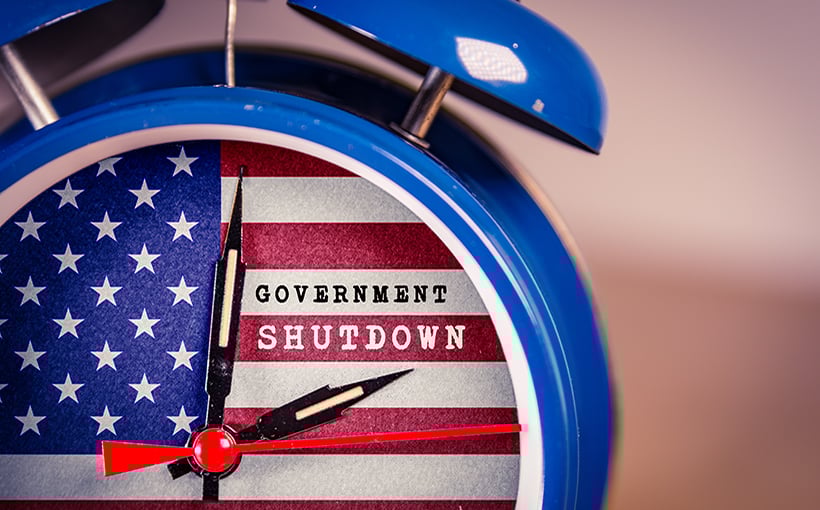
**U.S. Government Enters Ninth Day of Shutdown — Limited CRE Impact, Broader Economic Concerns Loom**
As of October 9, the U.S. government has entered its ninth day of a shutdown, with Congress still at an impasse over a funding agreement to reopen operations. The result has included furloughs for federal employees and disruptions to air travel as lawmakers remain gridlocked.
**The Good News: Commercial Real Estate Mostly Unaffected**
According to a recent video report from Marcus & Millichap, commercial real estate operations remain largely unaffected by the shutdown. Financing remains available, including through agencies like Fannie Mae and Freddie Mac, and transactions are still being completed as planned.
John Chang, Senior Vice President at Marcus & Millichap, explained that operations within the CRE sector tend to proceed normally, even during government shutdowns. The one potential exception could involve delays in Department of Housing and Urban Development (HUD) payments. However, this would likely only become a concern if the shutdown lasts longer than 30 days.
**The Not-So-Good News: Broader Economic Ripples**
While CRE remains stable for now, the wider U.S. economy could feel the impact depending on the shutdown’s duration. Chang noted that extended closures could:
– Put downward pressure on overall economic growth
– Delay the release of critical economic data used for decision-making
– Shape or alter investor and business responses
**Looking at Historical Context**
Historical data from previous shutdowns offers some insight:
– The 2018–2019 partial shutdown lasted 35 days, resulting in the furlough of around 380,000 government workers and an estimated $11 billion hit to the economy, with $8 billion of that recaptured when government operations resumed.
– The 2013 full shutdown lasted 16 days and saw roughly 850,000 employees furloughed, contributing to an estimated $20 billion loss in GDP.
Current projections suggest this shutdown could see up to 750,000 government employees furloughed, with Chang estimating a possible reduction in GDP growth of 15 to 20 basis points per week, dependent on the shutdown’s length.
**Data Delays Complicate Fed Decisions**
Closed government agencies mean critical economic data—such as jobs reports and inflation metrics—aren’t being released. This creates challenges for the Federal Reserve, which depends on this information to adjust the federal funds rate.
Chang stated that although the anticipated interest rate cuts for October and December are likely to proceed, the Fed may have to make key decisions without complete economic data.
**Renewed Fears of Recession**
Recent data from the Bureau of Labor Statistics has signaled a softening job market, with layoffs increasing across government sectors. This could eventually affect consumer spending, home sales, healthcare data, and other key drivers of CRE demand.
If the shutdown continues, it may erode consumer and business confidence, potentially tipping the economy into a recession. Much depends on how long the shutdown lasts and how severely it undermines broader economic sentiment.
**A Cautious Optimism: Household Resilience**
Despite these challenges, Chang pointed to some positive fundamentals: household balance sheets remain strong, with healthy savings and relatively low debt-to-income ratios. This financial resilience could help buffer the economy in the short term.
“The shutdown is generating headlines,” Chang said, “but the long-term impact should be minimal. At the end of the day, investors should focus on the long game.”