
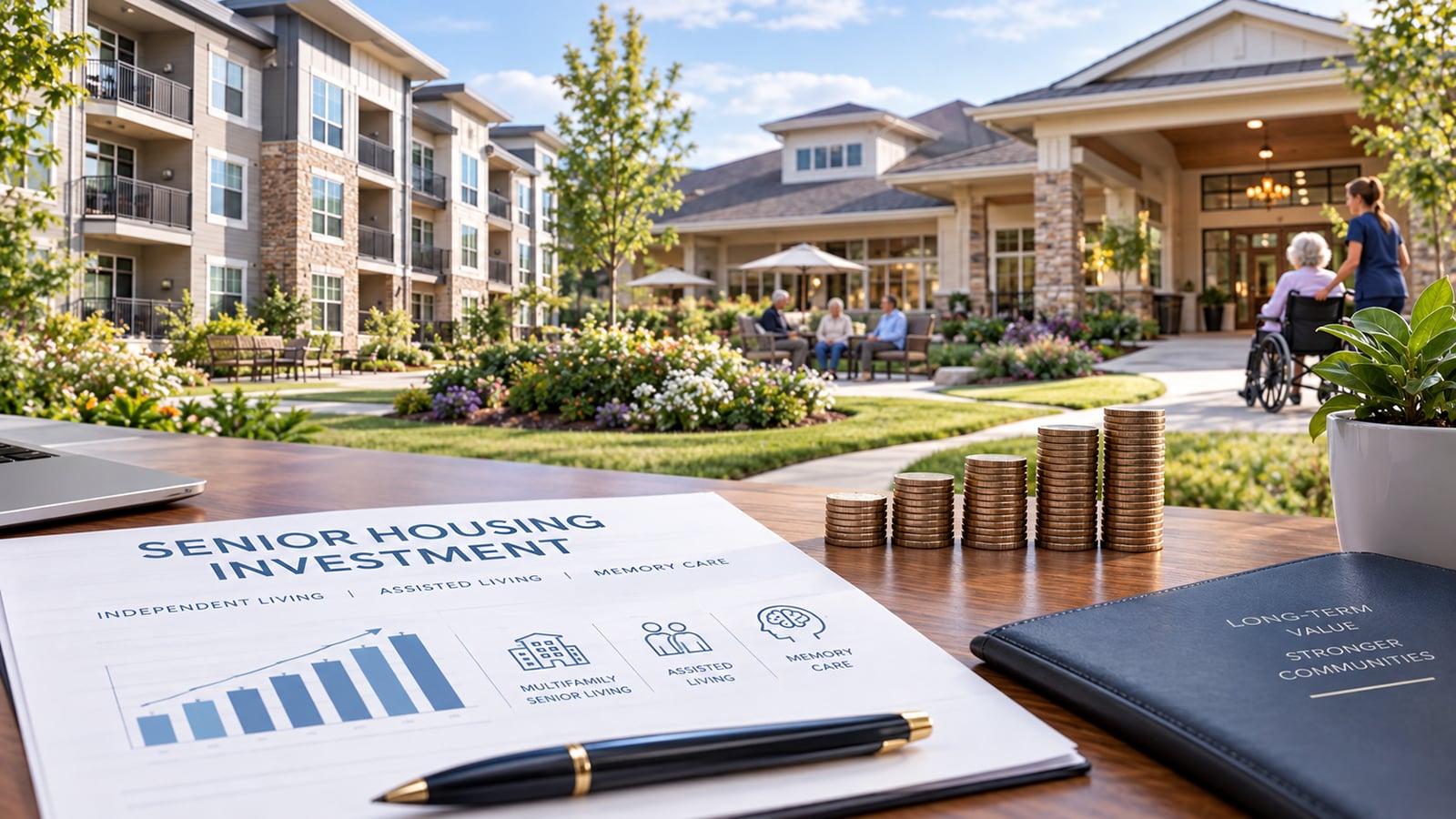
Senior housing has evolved from a niche within healthcare real estate into a sector that investors are watching more closely, supported by a recent Northmarq guide aimed at newcomers to the space.
Data from the National Investment Center for Seniors Housing & Care (NIC) shows that occupancy across 31 primary markets reached 90.4% in the third quarter of 2026, extending a run of 21 consecutive quarters of improvement. Within that total, independent living properties averaged 91.7% occupancy, while assisted living averaged 89.1%, underscoring broad-based demand across care levels.
Despite this strength, new construction is lagging. Rising construction costs, higher interest rates and more conservative construction lending are slowing the pace of groundbreakings. NIC noted that development is concentrating in Sun Belt growth corridors and in the suburbs of major metropolitan areas, even as national demographics point to widespread demand.
In the second quarter, a little more than 16,000 senior housing units were under construction across the primary markets, split between independent living and assisted living projects. Annual inventory growth held at 0.4%, a rate that falls well short of what would be needed to keep occupancy around current levels as the population ages.
NIC estimates that maintaining national occupancy at roughly 90% through the late 2030s would require more than 100,000 new units in most years. By comparison, the present development pace is about 10,445 units annually, or roughly 10% of that requirement, underscoring a significant and persistent supply gap.
Northmarq frames senior housing as spanning five categories: independent living, assisted living, memory care, skilled nursing and low-income senior housing. Independent living is described as operating most similarly to conventional multifamily, while skilled nursing is characterized as the most operationally intensive segment and the one most closely tied to government reimbursement.
For investors accustomed to traditional multifamily, Northmarq emphasizes that senior housing should be viewed as an operating business layered on top of real estate. Property performance is closely linked to operator quality and stability, not just the physical asset or local rent dynamics.
Key value drivers highlighted in the guide include proximity to adult children and healthcare facilities, strong growth in the population aged 75 and older, limited opportunities for new construction, modern units with private rooms and bathrooms, and a balanced mix of private-pay and government-sourced revenue. On the downside, operator turnover, financial distress and deferred maintenance can erode performance, as can new competition in smaller submarkets, heavy reliance on Medicaid and Medicare payments, and escalating labor costs.
Looking ahead, Northmarq points to several trends for investors to monitor: the convergence with multifamily practices such as revenue management and apartment-style amenities, growing middle-market demand that could reward cost-conscious product, and the adoption of technology such as remote monitoring, telehealth and smart building systems. The guide also flags a recovering capital markets environment, with debt and equity returning after post-pandemic disruption, and ongoing operator consolidation, which may create opportunities for acquisitions and recapitalizations.
Northmarq concludes that senior housing is a distinct asset class rather than an extension of either multifamily or traditional healthcare real estate. Understanding occupancy trends, demographic growth, competitive supply, operating performance and operator capabilities is presented as an essential starting point for investors evaluating how to deploy capital in the sector.