**Micro-Flex Industrial Comes into Its Own: Q&A With Method Architecture’s Eric Hudson**
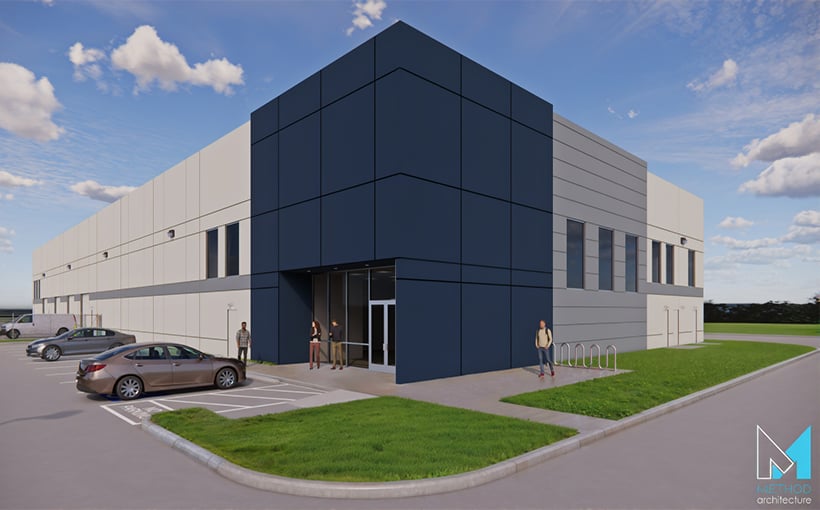
*Pictured: Rendering of South Austin Commerce Center in Buda, Texas. Designed by Method Architecture.*
—
Not so long ago, the industrial development mantra was “bigger is better.” However, trends are shifting. Micro-flex industrial buildings—compact, versatile facilities—have begun capturing the industry’s attention. ConnectCRE spoke with Eric Hudson, Partner and Industrial Leader at Method Architecture, to understand the growing appeal of these smaller structures.
**What is a micro-flex industrial building?**
According to Eric Hudson, a micro-flex facility is generally a pre-engineered metal building (PEMB) or a tilt-wall structure, typically sized between 15,000 and 40,000 square feet for a single tenant. These buildings often have bay depths ranging from 120 to 200 feet, are crane-ready with capacities of 5 to 20 tons, and may include outside storage or laydown yards.
“In comparison, standard bulk distribution buildings are much larger—100,000 to 500,000+ square feet—with bay depths starting at 250 feet,” Hudson noted. “Micro-flex spaces accommodate a variety of light industrial uses with an emphasis on flexibility. They’re also referred to as small-bay or shallow-bay developments.”
**Who are the primary users?**
“Tenants are typically light manufacturers and fabricators,” said Hudson. “Think woodworking shops, metal finishing businesses, small-scale assembly operations, and machine shops. These spaces are also ideal for trade contractors, food and beverage packaging operations, and businesses needing showroom-warehouse combinations.”
He emphasized that this type of facility prioritizes features such as grade-level loading, customizable office space, and yard space—suiting operations with minimal long-haul trucking and more specialized equipment needs.
**Is this trend new?**
“Not at all,” said Hudson. “Micro-flex buildings have been around in various forms for decades. What’s new is the surge in demand and interest. Historically, these projects were overlooked by institutional investors, who favored larger developments with higher returns.”
**What’s driving that demand?**
Hudson pointed to several contributing factors. “Changes in trade and tariff policies have made offshoring less attractive, fueling a resurgence in domestic manufacturing. With 98% of manufacturing businesses classified as small, the need for micro-flex space is significant.”
He added that many small manufacturers and suppliers prefer infill locations closer to clients and resources. Unfortunately, much of the current small-bay inventory is outdated, lacking the modern infrastructure—such as power, layout, and connectivity—necessary for advanced operations.
Additionally, tax provisions like Section 179 under the One Big Beautiful Bill Act allow small businesses to deduct the full cost of equipment purchases. “This makes it more feasible for these users to set up quickly and affordably in micro-flex spaces,” Hudson explained.
**What should developers consider?**
“Flexibility is key,” said Hudson. “A typical spec includes clear heights from 20 to 32 feet, building depths of 80 to 120 feet, and office buildouts of 2,000 to 5,000 square feet. Grade-level loading is essential—often with a single dock.”
He also noted that, while these smaller facilities usually require less parking than large distribution centers, careful attention must be paid to traffic flow, site layout, and floor-area ratio. “Power accessibility and data infrastructure are now baseline requirements.”
“Just as important,” he added, “is understanding the regional market. Tenant needs can vary greatly by location, so successful developments must be tailored accordingly.”
**What’s the future of the micro-flex sub-sector?**
“The outlook is strong, supported by manufacturing incentives and low vacancy rates in this product type,” Hudson concluded. “Large developers generally aim for tenant footprints between 50,000 and 80,000 square feet. That leaves a large gap in the market for smaller users—precisely what the micro-flex model is built to serve.”
However, there are challenges. “Capital availability and return expectations could limit growth. The yields on micro-flex projects are usually smaller and require longer hold periods, making them less attractive to institutional investors. Expansion will depend on committed developers with a longer-term strategy.”