Global investment firms KKR and AEW Capital Management are seeking to sell parts of their commercial real estate portfolios in China as international capital continues to pull back from the country’s extended property downturn, according to Bloomberg News.
Bloomberg reported that KKR is marketing nine properties across China. The portfolio includes a high-end apartment complex located in suburban Beijing and a hotel asset on Shanghai’s historic Bund waterfront. These assets span multiple property types within the commercial universe, reflecting a broader effort to trim exposure rather than a single-asset disposition.
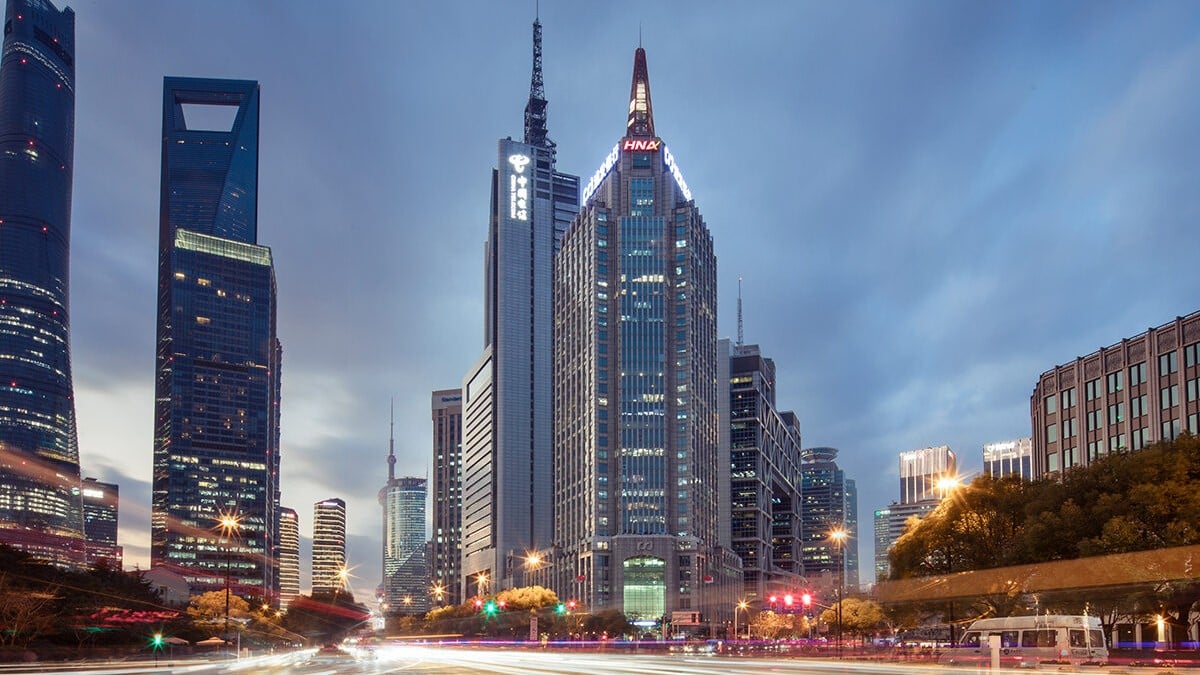
AEW is also moving to sell down its holdings, focusing on office and mixed-use assets in major Chinese cities. According to Bloomberg, the firm is pursuing buyers for several office properties in Beijing as well as Shanghai’s Pudong Development Bank building. The latter is a prominent tower in Shanghai’s Pudong area and is highlighted as a key asset being brought to market.
Sources cited by Bloomberg indicated that both KKR and AEW expect any sales proceeds to be sufficient to repay outstanding bank loans tied to these assets. Those same sources suggested this outcome would imply current valuations at roughly 50% to 60% of the original purchase prices. While that level may allow repayment of debt, it also points to a significant reset in pricing compared with the period when these properties were acquired.
The potential exits come against a backdrop of sustained weakness in China’s commercial property sector, marked by years of declining asset values and subdued leasing demand. The challenges have been particularly acute for foreign owners that expanded into the market during earlier growth phases and are now navigating a slower economy and softer fundamentals.
Over the past 15 years, overseas investors collectively deployed nearly $140 billion into Chinese commercial real estate, Bloomberg reported. That capital supported acquisitions across multiple asset types and geographies within the country. However, the same investor cohort has recently shifted its stance, with many firms becoming net sellers as they reassess risk and performance expectations in light of the economic slowdown and persistent oversupply.
The sale efforts by KKR and AEW underscore how global institutions are responding to the repricing taking place in China’s property markets. Bringing assets to market at levels that primarily aim to clear bank debt illustrates the pressure on foreign owners to manage leverage and rebalance portfolios, even when that involves realizing substantial discounts to original purchase costs.
For now, the outcome of the planned dispositions remains contingent on buyer appetite and pricing in a market characterized by reduced demand and an ample supply of assets. Nonetheless, the strategies outlined by KKR and AEW reflect the broader shift among overseas investors from expansion to capital recovery and risk reduction in China’s commercial real estate sector.