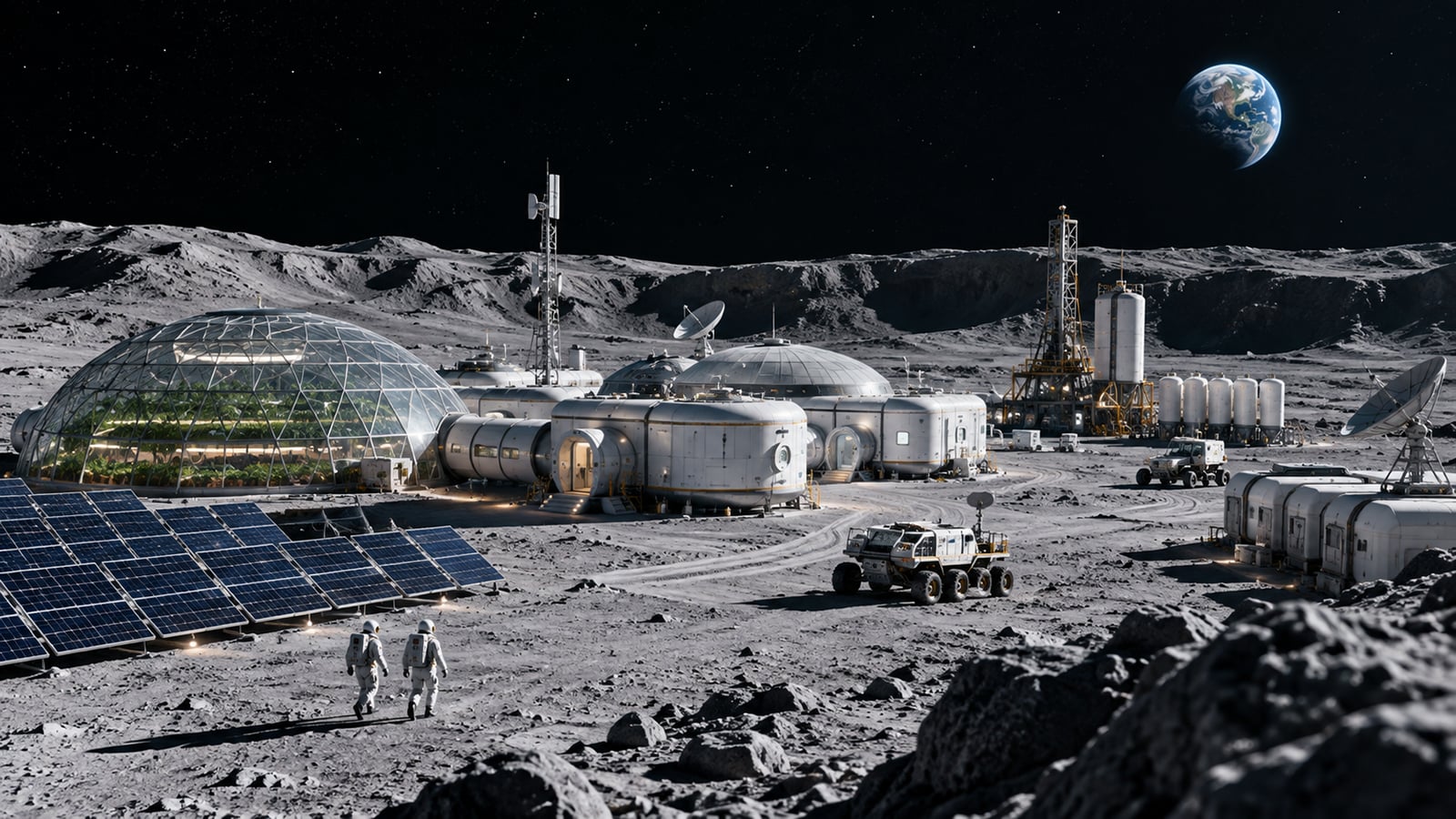
Deloitte’s report “Building the Lunar Economy” positions the Moon as a rapidly emerging frontier where scientific missions and growing commercial ambitions could converge into a functioning economic ecosystem. The study, which draws on perspectives from industry leaders, concludes that what was once a niche segment of the space sector is now advancing quickly as barriers to entry fall and the potential value of lunar resources becomes clearer.
According to Raquel Buscaino, Head of Novel & Exponential Technologies (NExT) at Deloitte Consulting LLP, the lunar economy remains in an early stage but could mature once foundational infrastructure is in place. She notes that dependable systems for transportation and logistics, power, communications and navigation, construction, and life support will be prerequisites before more extensive commercial activity can scale. Once those building blocks are established, they could underpin downstream activity in areas such as resource extraction, space-based manufacturing, and data services.
A significant focus of near-term planning is the Moon’s South Pole, which combines challenging terrain with attractive resource potential. The region is characterized by jagged ridges and deep craters, including permanently shadowed areas that may hold water ice, alongside nearby zones that receive near-continuous sunlight suitable for solar power. These attributes are helping drive mission planning for initiatives such as NASA’s Artemis Base Camp and China’s International Lunar Research Station, which are considering the South Pole for long-term installations.
Buscaino highlights water ice as a critical resource, both for sustaining human presence and for producing rocket propellant to support return trips to Earth and deeper-space exploration. However, she emphasizes that the most valuable lunar locations will be defined not only by natural conditions like sunlight and ice, but also by the quality and extent of infrastructure built around them. In her view, “location, location, location” on the Moon will reflect a blend of natural advantages and human-made support systems that make those advantages usable.
Unlike Earth-based real estate, lunar activity is constrained by the current Outer Space Treaty, which does not recognize traditional territorial ownership of the Moon. As a result, familiar land concepts such as deeds, property lines, and conventional leasing structures do not directly apply. Buscaino suggests that more tailored governance mechanisms could evolve over time, including time-bound operating permissions, resource-extraction rights, and coordination frameworks for infrastructure and active sites. The aim would be to give operators enough certainty to invest and function safely while preserving principles such as transparency, access, and non-interference.
Governments are expected to act as the first anchor customers in this emerging market. As national space agencies expand sustained lunar operations, their needs for power, communications, landing support, logistics, and mobility could catalyze shared infrastructure that later supports a broader user base. Buscaino draws an analogy to the evolution of GPS: initially built for government purposes, the system ultimately created a platform for wide-ranging commercial applications once the underlying infrastructure existed.
Looking ahead, the report stresses that notable engineering challenges, long development timelines, and uncertain commercial viability still stand between current missions and a mature lunar economy. Progress will hinge on technology, geopolitics, and continued investment. For future commercial real estate participants, Buscaino indicates that value is likely to center on predictable access to critical infrastructure, favorable operating conditions, and frameworks that allow multiple operators to share locations without interfering with one another, with operating rights rather than property deeds forming the foundation of lunar “real estate.”