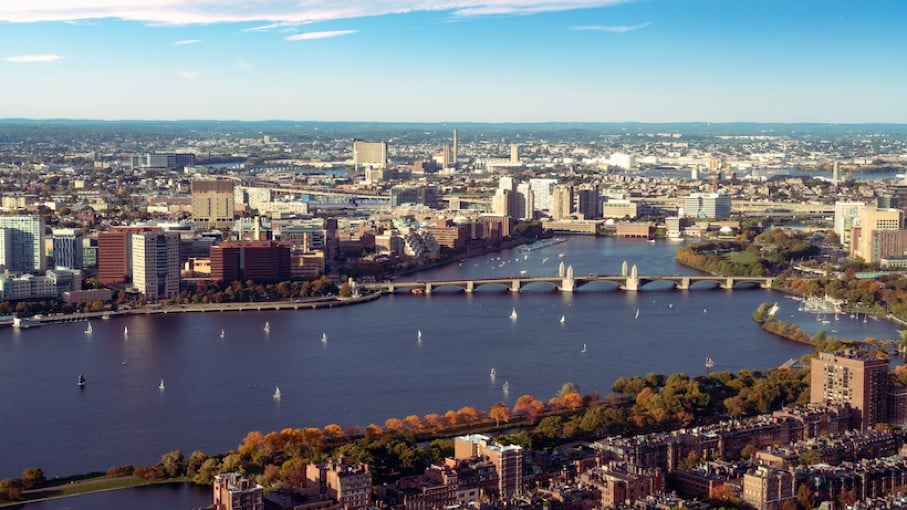
Office fundamentals in the Boston metro are tightening as demand modestly outpaces the pace of new completions, according to a recent Marcus & Millichap report. Market-wide vacancy is projected to edge down by 10 basis points year-over-year to 19.1% in the fourth quarter, marking the second consecutive improvement after the region recorded its first annual decline in vacancy since 2022 earlier this year. Gains have been most notable in select Class A buildings and in larger office districts that have captured a meaningful share of current leasing activity.
Suffolk County has been a primary driver of the recent momentum. The report notes that the county registered more than 1.3 million square feet of net absorption during the first half of the year. That demand helped push vacancy in Suffolk County down from 21.6% in June 2025 to 20.4% one year later. Vacancy also moved lower in eight additional submarkets across the metro, while markets such as Worcester maintained already-low availability levels. In contrast, Cambridge saw conditions soften, with vacancy there climbing 250 basis points to 22.8% over the same period.
On the supply side, roughly 3.3 million square feet of office space is scheduled to deliver in 2026. The pipeline is concentrated in a limited number of larger properties, with most of the upcoming projects exceeding 300,000 square feet. While this new inventory will add options for tenants seeking modern space, the volume of construction remains measured relative to current absorption trends, contributing to the gradual tightening in overall vacancy.
Rents are showing modest growth alongside the improving occupancy picture. Across the Boston metro, average asking office rent is expected to reach about $38.75 per square foot by year-end, representing a 1.2% increase from the prior year. Cambridge remains the metro’s highest-priced office market, with asking rents around $72.54 per square foot, underscoring the premium commanded by that submarket despite its recent uptick in vacancy.
Investment metrics highlight a period of repricing for Boston office assets. Marcus & Millichap reports that average sale pricing has fallen from more than $370 per square foot in 2022 to roughly $283 per square foot by mid-2026. Over the same timeframe, average cap rates expanded from 6.7% to 7.7%, indicating that investors are requiring higher yields amid evolving risk perceptions and capital markets conditions.
The broader economic backdrop is expected to remain supportive but uneven across sectors. The Boston region is projected to add approximately 25,000 jobs in 2026, with education and health services playing a substantial role in that growth. However, several traditional office-using industries, including finance and professional and business services, continue to operate below their 2022 employment peaks. The report also notes that uncertainty surrounding research funding and pockets of weakness in the life sciences sector could temper future office demand, even as near-term vacancy trends remain relatively constructive.