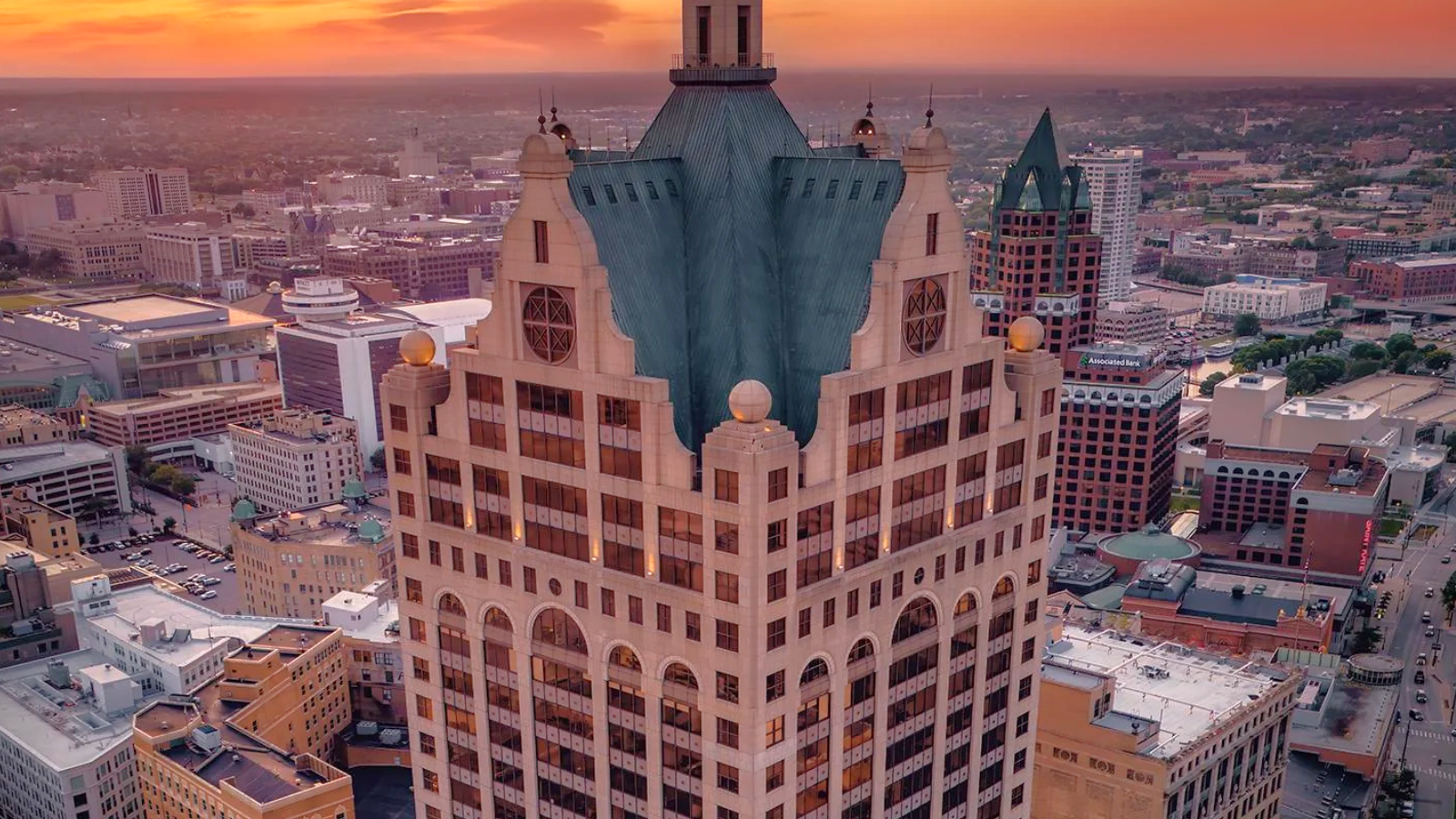
Dwight Capital has closed a $114 million HUD 221(d)(4) substantial rehabilitation loan to fund the conversion of 100 East Wisconsin, an existing 34-story office tower, into a 373-unit luxury apartment community. The financing supports the transformation of the property from office use to multifamily residential, aligning HUD construction-to-permanent financing with a large-scale adaptive reuse project.
The property is located at 100 East Wisconsin in the heart of Milwaukee’s downtown central business district, directly along the Milwaukee River. The building is currently the third-tallest structure in Wisconsin, and the planned conversion will make it the tallest residential building in the state once the project is completed.
Upon conversion, the community will deliver a mix of studio, one-, two-, and three-bedroom apartments, positioning the asset as a high-rise luxury multifamily offering in Milwaukee’s core business district. While the specific unit sizes and interior features are not detailed, the project is described as a luxury apartment community and will fully repurpose the former office space for residential use.
The City of Milwaukee is supporting the redevelopment with a tax increment financing package of up to $16.6 million. This public support combines with the HUD 221(d)(4) financing to form a significant capital stack for the project. The closing represents the largest multifamily HUD loan ever completed in Wisconsin, the largest multifamily loan approved by HUD’s Midwest Region Office, and the largest HUD 221(d)(4) construction loan in Dwight Capital’s history.
Loan proceeds are earmarked for both the construction phase and the permanent financing of the development, allowing a single execution to carry the project from rehabilitation through long-term stabilization. Dwight Capital Managing Director Keith Hoffman and Jack Tawil originated the loan on behalf of the developers, Klein Development, led by Joe Klein, Michael Klein, and Derek Schneider, and MOS R.E., led by Johnny Vassallo.
The transaction underscores ongoing capital deployment into multifamily conversions of existing office buildings in Milwaukee’s central business district, with federal HUD financing and municipal tax increment support both playing key roles in moving the project forward. Specific loan terms such as rate, term length, and amortization schedule were not disclosed.