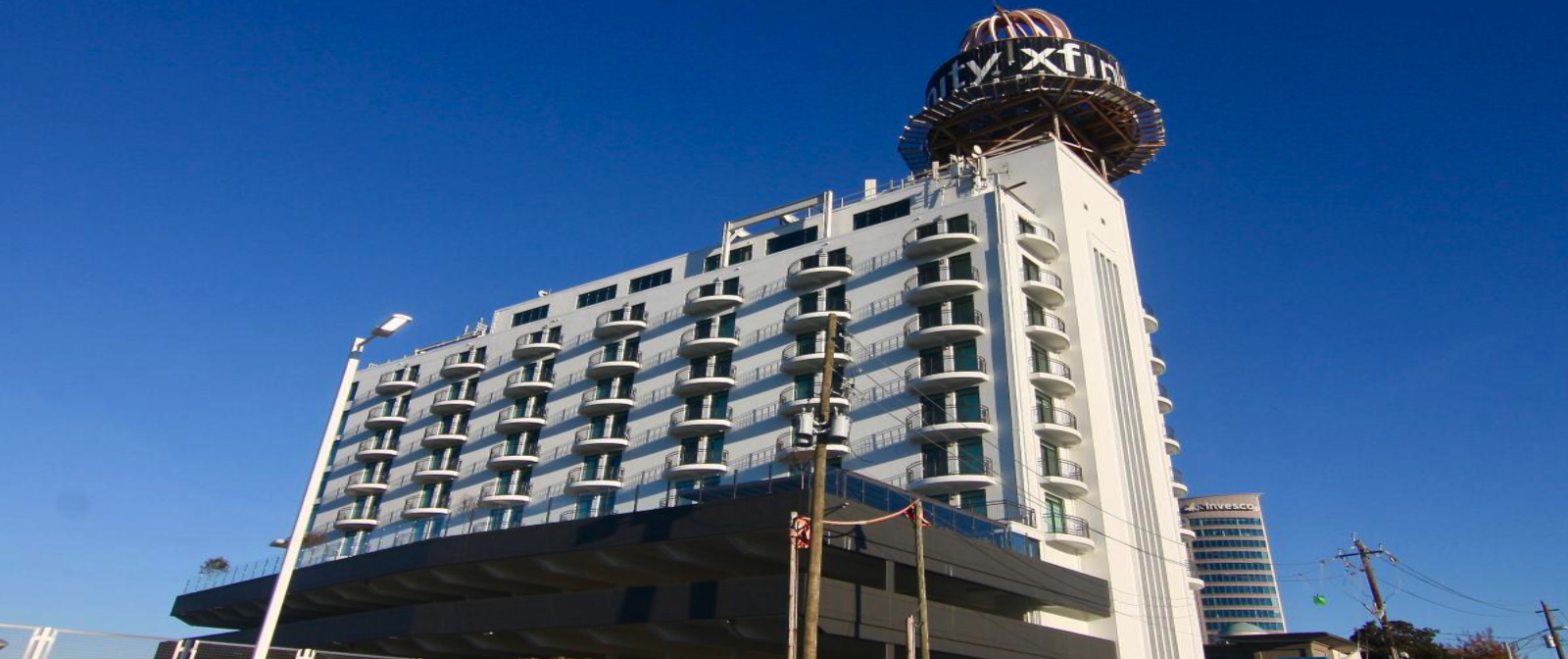
Fannie Mae has taken control of The Peach Atlanta, a converted office-to-residential high-rise, through foreclosure and subsequently transferred ownership to real estate loan servicer Trimont. According to reporting referenced in the source article, Fannie Mae acquired the property in April for $24.6 million before moving it to Trimont as part of the foreclosure resolution.
The Peach Atlanta has a long and uneven history, having changed hands several times over more than five decades while remaining largely vacant for much of that period. The most recent pre-foreclosure owner was Peach Hospitality, which purchased the high-rise in 2016 for $8.5 million. Despite multiple ownership transitions, the property struggled to achieve sustained occupancy, even after its conversion from office to residential use.
In 2021, Peach Hospitality launched a comprehensive overhaul of the building aimed at repositioning the asset. As part of that effort, the company announced that it had secured an initial $17.5 million proprietary bridge loan from Lument. The financing was intended to refinance the 68-unit property, fund the completion of renovations, pay down existing obligations, and ultimately stabilize occupancy within the building.
The foreclosure indicates that the capital stack and business plan for The Peach Atlanta did not progress as anticipated despite the infusion of bridge financing and the conversion to residential use. While the source information confirms that Fannie Mae stepped in through foreclosure and then transferred the asset to Trimont, it does not detail the circumstances that led to the enforcement action or the specific performance metrics that triggered it.
Trimont now holds ownership of the high-rise following the foreclosure-related transfer from Fannie Mae. However, the servicer’s strategy for the property has not been disclosed. It remains unclear whether Trimont plans to complete or modify the prior renovation program, pursue lease-up under the current multifamily configuration, market the asset for sale, or consider an alternative repositioning approach.
The situation at The Peach Atlanta underscores the execution risk associated with complex conversions of older high-rise assets, particularly when properties have long histories of vacancy and require significant capital to stabilize. It also highlights how bridge financing structures, even when paired with a major agency counterparty like Fannie Mae, do not eliminate the potential for foreclosure outcomes if a sponsor’s business plan does not materialize as expected.