
CRE Market Beat
Weekly Intelligence Brief · July 24, 2026
Intelligence Take
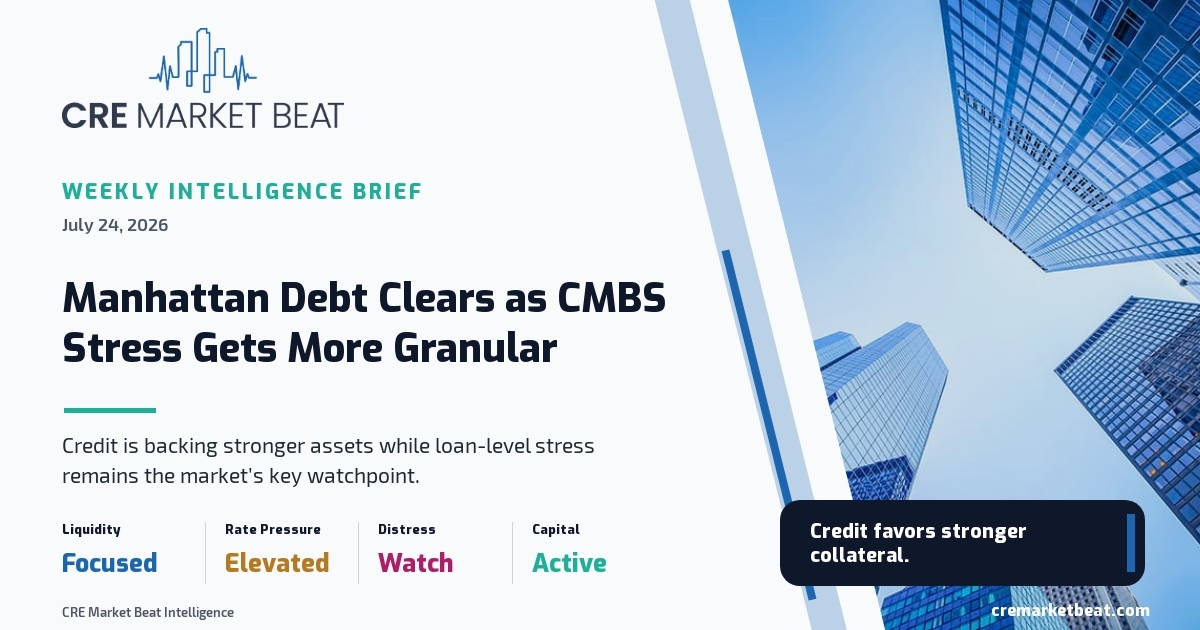
Manhattan Debt Clears as CMBS Stress Gets More Granular
Construction, bridge and refinancing executions showed capital still backing defensible assets, while special servicing, foreclosure and bankruptcy outcomes kept weak collateral under scrutiny.
CRE Market Beat’s weekly read: institutional capital is moving, but through underwriting-intensive channels that reward sponsorship, income durability and asset quality rather than broad market momentum.
Manhattan Credit / CMBS Watch
Macro & Capital Stack Lens
Conviction Capital Is Moving, Broad Easing Is Not Yet Confirmed
Regime: Credit-disciplined deployment into defensible CRE, with private capital favoring needs-based and operationally specialized sectors while broader assets remain proceeds-constrained.
Liquidity: Mixed to slightly better for favored sectors, especially scaled or durable-income strategies; constrained for transitional, highly levered and income-impaired assets.
Risk appetite: Risk appetite is measured rather than speculative. Institutions are willing to form platforms and fund sizable deals where secular demand, tenant durability or market depth improves downside visibility.
Capital stack: The week’s financing activity points to structure-dependent liquidity: senior debt, mezzanine, agency, bridge and private-credit capital are available, but only where collateral quality and sponsorship support conservative underwriting.
Signal Dashboard
Favored assets can transact; weaker collateral remains constrained.
|
CMBS and foreclosure signals require loan-level monitoring.
|
Debt-service math still limits leverage and proceeds.
|
Projects need sponsorship, demand visibility and takeout confidence.
|
Debt and equity are backing higher-confidence assets.
|
New York volume shows measured institutional re-entry.
|
Dominant Themes
|
Dominant Theme
Debt Is Clearing for Underwritten Winners
Senior, agency, bridge, mezzanine and bank financing closed for well-sponsored multifamily, hospitality, industrial and select office assets, confirming that credit channels are open for high-confidence collateral.
Capital markets relevance: The macro regime supports this pattern: lenders and private credit are willing to deploy into assets with strong sponsorship and durable income, but not enough to signal market-wide credit expansion.
|
|
Dominant Theme
Office Liquidity Is Quality-Gated
Manhattan investment sales, One World Trade occupancy and Google’s Sunnyvale recommitment showed demand for high-quality office, while CMBS surveillance and valuation concerns reinforced pressure on obsolete or weakly leased assets.
Capital markets relevance: Office credit is increasingly asset-specific: trophy and leased assets can transact or refinance, while weaker inventory faces proceeds gaps and potential recapitalization needs.
|
|
Dominant Theme
Distress Is Moving From Headlines to Loan-Level Surveillance
CMBS delinquencies improved in headline terms, but higher special servicing, foreclosure activity and bankruptcy sales showed stress migrating through specific borrowers, assets and maturity events.
Capital markets relevance: Institutional investors should monitor special servicing, maturity defaults and enforcement outcomes as leading indicators of price discovery.
|
|
Dominant Theme
Development Is Advancing Where Demand Is Visible
Large hospitality, industrial, resilience and multifamily projects moved ahead, but the macro lens suggests development finance remains narrow and tied to sponsorship, phasing and demand conviction.
Capital markets relevance: New supply is not stalled, but capital appears focused on demand-driven corridors and projects with strategic sponsorship rather than speculative growth.
|
Asset Class Pulse
|
Multifamily / Living
Active · Positive
Multifamily showed the broadest financing depth, led by Lower Manhattan construction financing and West Coast value-add equity formation.
Story count: 9
|
|
Office
Bifurcated · Mixed
Quality office drew tenant and sale signals, while CMBS exposure and obsolescence kept weaker assets under pressure.
Story count: 8
|
|
Industrial
Constructive · Positive
Industrial activity remained constructive, with acquisitions, bank lending and new logistics supply in growth corridors.
Story count: 6
|
|
Hospitality
Active · Positive
Hospitality was led by Brickell refinancing, Resorts World expansion and Ryan Field redevelopment.
Story count: 3
|
|
Healthcare
Positive Macro Signal · Improving
Healthcare was the strongest macro private-capital signal, supported by platform formation around durable outpatient demand.
Story count: 1
|
Market Heatmap
Large-scale office, multifamily and hospitality capital activity
New York produced the week’s strongest institutional signal through Manhattan sales volume, Lower Manhattan multifamily financing, Turtle Bay bridge debt, One World Trade leasing and Resorts World expansion.
Institutional relevance: Market depth is attracting both debt and equity where assets meet quality, sponsorship and demand thresholds.
Story count: 6
|
Adaptive reuse financing and CMBS monitoring created a two-sided market signal
Chicago showed both opportunity and risk, with River North conversion financing, Fulton Market office debt, Ryan Field redevelopment and Aon Center-related CMBS stress.
Institutional relevance: The market offers repositioning and financing opportunities, but loan-level surveillance remains essential.
Story count: 5
|
Core hospitality refinancing and niche construction lending showed lender appetite
Miami capital markets remained functional for core hospitality and climate-controlled self-storage development.
Institutional relevance: Capital is supporting durable demand and strong sponsorship in a market where underwriting still must account for insurance and operating-cost complexity.
Story count: 2
|
Industrial development pipeline added new Class A supply
The Katy Prairie Business Park plan added a major Class A industrial supply signal in the Houston corridor.
Institutional relevance: New supply reinforces developer confidence but requires monitoring absorption and tenant demand.
Story count: 1
|
Logistics development continued in an active growth corridor
Goodyear’s Phase II industrial groundbreaking reinforced West Phoenix as an active logistics development corridor.
Institutional relevance: The corridor remains a growth market, but added supply will test demand assumptions and tenant absorption.
Story count: 1
|
Capital Markets Snapshot
Capital markets were functional but filtered through sponsorship, collateral quality and demand visibility. The week showed debt and equity formation across preferred asset types, while CMBS and maturity exposure kept underwriting conservative.
Private Credit
Private credit is supporting favored collateral and defensive platform strategies, with the macro signal strongest in healthcare and the CRE signal visible in structured multifamily finance.
Bank Lending
Banks funded select industrial and office-related executions, indicating balance-sheet capacity exists for assets that meet tighter risk standards.
Refinancing Market
Refinancing cleared for assets such as Turtle Bay multifamily and Brickell hospitality, but weaker or overlevered assets still face debt-service and proceeds gaps.
Construction Lending
Construction finance appeared in Lower Manhattan multifamily, River North adaptive reuse and Miami self-storage, but remains tied to strong sponsorship and project conviction.
Distress / Repricing Watch
Distress remained concentrated rather than systemic, with the clearest pressure in CMBS surveillance, office valuation gaps, foreclosure and stalled urban development. Loan-level outcomes matter more than headline delinquency direction.
Distress Level
Elevated
Repricing Direction
Basis resets are becoming actionable where maturity events, court processes or lender pressure force new sponsorship.
Investor Read-Through
Distress is most actionable where basis reset, lender pressure, or asset conversion can create a financeable new entry point.
Opportunity Watch
Opportunity is forming where capital availability intersects with durable demand, credible sponsorship or repriced control. The best near-term setups appear in structured multifamily finance, quality office, adaptive reuse and defensive platform strategies.
Opportunity Level
Asset-Specific
Capital Stack Angle
Opportunity is strongest where selective liquidity, sponsor quality, durable demand, and reset basis intersect.
Investor Read-Through
The best opportunities are not broad beta trades; they are asset-level situations with credible cash flow, capital access, or repositioning logic.
Top 4 Intelligence Stories
|
Story 1 · Multifamily / Living · Construction Financing
JLL Secures $617M for Lower Manhattan Apartment Tower
New York — Financial District
A $617M multi-layered financing package was arranged for a Lower Manhattan multifamily tower.
Why it matters: It is the clearest weekly signal that institutional construction finance can still clear for high-conviction housing in deep markets.
Macro connection: The execution fits the macro regime: capital is not broadly abundant, but lenders will fund projects with sponsorship, demand visibility and structured risk allocation.
|
|
Story 2 · Capital Markets / Finance · CMBS Stress
Trepp Data Shows CMBS Stress Beneath Better Delinquencies
Chicago
Trepp data showed lower delinquencies but higher special-servicing balances, including severe collateral stress tied to a major Chicago asset.
Why it matters: CMBS special servicing remains a leading indicator for proceeds gaps, workout timing and valuation resets.
Macro connection: With funding-cost uncertainty still framing underwriting, maturity-exposed assets can deteriorate even when broad delinquency metrics look better.
|
|
Story 3 · Office · Investment Sales
Manhattan Investment Sales Rise to Strongest H1 Since 2022
New York City
Manhattan investment sales reached $9.87B in H1, with a $730M Park Avenue Tower trade highlighting Class A liquidity.
Why it matters: The story is a key price-discovery and liquidity signal for institutional office investors after a prolonged dislocation.
Macro connection: The macro backdrop favors assets with durable income and institutional depth, which explains why top-tier Manhattan office can trade while weaker office remains challenged.
|
|
Story 4 · Mixed-Use Development · Bankruptcy Sale
Court Approves $470M Oceanwide Plaza Sale in DTLA
Los Angeles — Downtown Los Angeles
A bankruptcy court approved the $470M sale of DTLA’s stalled Oceanwide Plaza project.
Why it matters: Distressed development resolutions can remove project uncertainty and create repriced entry points for new sponsors.
Macro connection: In a credit-disciplined market, stalled projects require new basis, new sponsorship and realistic completion economics to attract capital.
|
Watch Whether Targeted Capital Becomes Broader Market Velocity
This week confirmed that institutional CRE capital is not absent; it is underwriting-intensive and concentrated in assets with stronger demand, sponsorship and financing logic. The clearest risk is that asset-level stress remains masked by improving headline metrics until maturities, extensions or special servicing decisions force price discovery.
Forward watch: Monitor CMBS special servicing, bank lending standards, debt fund activity beyond bridge and rescue capital, healthcare platform formation, construction-loan availability and transaction volume outside New York and other favored markets.
CRE Market Beat · Institutional CRE Intelligence
Weekly market-state intelligence across CRE capital markets, liquidity, distress, development, and opportunity signals.