**Empty Big Boxes: Crisis or Opportunity?**


*Daniel Herrold*
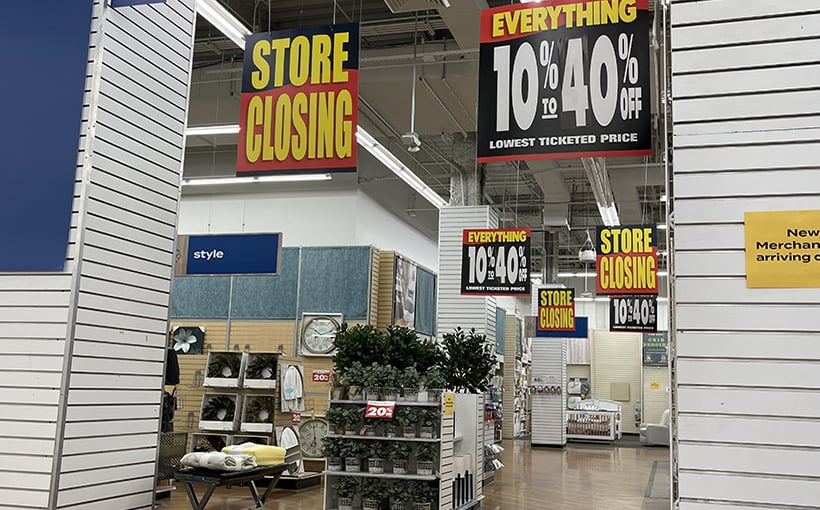
Over the last few years, many big-box retailers have found themselves in turbulent waters. The following high-profile names have filed for bankruptcy or shuttered locations entirely:
– JOANN’s filed for bankruptcy again in 2025.
– Big Lots declared bankruptcy in 2024, with a limited number of stores still operating.
– Bed Bath & Beyond closed all physical locations in 2023 and transitioned to an online-only model.
– At Home filed for bankruptcy in mid-2025 and has since closed multiple stores.
Despite the alarming wave of closures, there is a silver lining. The vacated retail space is being steadily backfilled, with off-price retailers leading the charge. Burlington, Ross, and the TJX brands (including T.J.Maxx, Marshalls, and HomeGoods) are actively expanding and taking over many of these spaces.
According to Daniel Herrold, Senior Vice President of Investment Sales at Northmarq, “Backfilling has been steady with off-price leading the charge. Burlington, Ross and the TJX banners are taking much of this space, and are still in expansion mode.”
**Not All Boxes Are Created Equal**
While the circumstances vary, the affected big box retailers often share a similar profile. Herrold points out that “large store footprints, thin margins, and middle-income customers who have shifted spending toward value-driven concepts” are common traits among these struggling tenants.
Importantly, though, these closures aren’t weighing heavily on the broader retail market. As of 2025, national average vacancy remains between 4% and 5%.
The real challenge, Herrold explains, lies in replacing hard-to-place assets—namely, department store spaces. Retailers like Macy’s, Kohl’s, and JCPenney are scaling back or quietly exiting locations, leaving behind sizeable footprints that are not easily repurposed.
Still, with new construction at all-time lows and demand holding strong, certain big box spaces remain highly valuable. “The better boxes stay in high demand,” Herrold noted.
**What’s in It for Investors?**
For savvy investors, these empty spaces can offer opportunity—particularly for those with experience in entitlement work and redevelopment.
“Most of these assets come with no income because the tenant is already gone,” Herrold said. Even if the lease still technically exists, the property isn’t producing rent if it’s sitting dark.
As a result, these investments are typically not about immediate cash flow. Instead, the value lies in the land, the location, and the site’s potential future use. “It’s about what can be built or repurposed there,” Herrold said, adding that trying to fill the space with a new tenant or subdivide it might not yield the best returns. “The value is almost always in what the property can become—not what it is today.”
**Looking Ahead**
While name brands like TJ Maxx, Burlington, and Ross are absorbing some of the vacant space, redevelopment may remain the highest and best use for many big box sites.
However, Herrold cautions against rushing into redevelopment without proper preparation. The process is complex and requires thorough feasibility assessments, zoning adjustments, and municipal approvals. “Once those steps are done, it comes down to execution,” he said.
Ultimately, this strategy is best suited for experienced redevelopment investors—those who can navigate regulatory hurdles and see the long-term potential. “Done right, the process breathes new life into the entire property and gives it a stronger, long-term foundation,” Herrold emphasized.
Empty big box stores may seem like symptoms of retail distress, but for the right investor, they may just represent the next big opportunity.