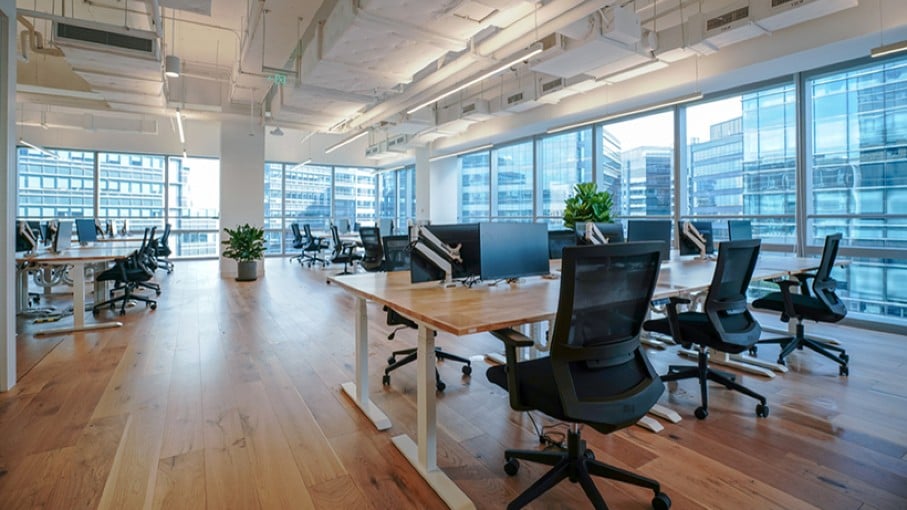
Fit-out costs for contemporary office space in the U.S. and Canada have undergone a structural reset, according to JLL’s U.S. and Canada Office Fit-Out Costs Guide 2026. Drawing on data from 50 cities across the two countries, the report finds that a medium-quality office fit-out now averages $295 per square foot. The figures reflect the cost of delivering space that aligns with current workplace expectations rather than legacy standards.
JLL’s guide places North American costs well above the global average. Worldwide, medium-quality office fit-outs average $205 per square foot, indicating a substantial premium for comparable space in the U.S. and Canada. The firm attributes this gap to persistent structural pressures across the construction and fit-out ecosystem, alongside limited supply capacity. These dynamics are contributing to a new baseline for what it costs to deliver modern office environments.
JLL notes that labor availability, trade conditions and rising technical complexity are all reinforcing higher cost levels in North America. The firm characterizes these factors as structural rather than cyclical, suggesting they are unlikely to reverse quickly. As a result, occupiers and owners cannot rely on a near-term drop in pricing to ease project budgets for office build-outs.
At the same time, JLL highlights the role of office quality in the competition for talent. The report underscores that businesses increasingly view investment in high-quality, tech-enabled space as a business requirement rather than a discretionary upgrade. From JLL’s perspective, workplace quality has become a primary lever for organizations seeking to attract and retain employees in the current environment.
Louis Molinini, head of Project and Development Services, Americas at JLL, cautions occupiers against postponing projects in the hope of more favorable pricing. He states that clients who delay commitments waiting for costs to fall are taking on significant risk, because the underlying pressures driving fit-out costs are not on a schedule that supports a “wait and see” approach. Molinini adds that the standard for what constitutes competitive office space has moved higher, implying that organizations looking to differentiate themselves in the labor market must align plans and budgets with the new cost realities identified in the guide.