**Hessam Nadji Predicts Major Capital Influx into Commercial Real Estate at Connect Apartments 2025**
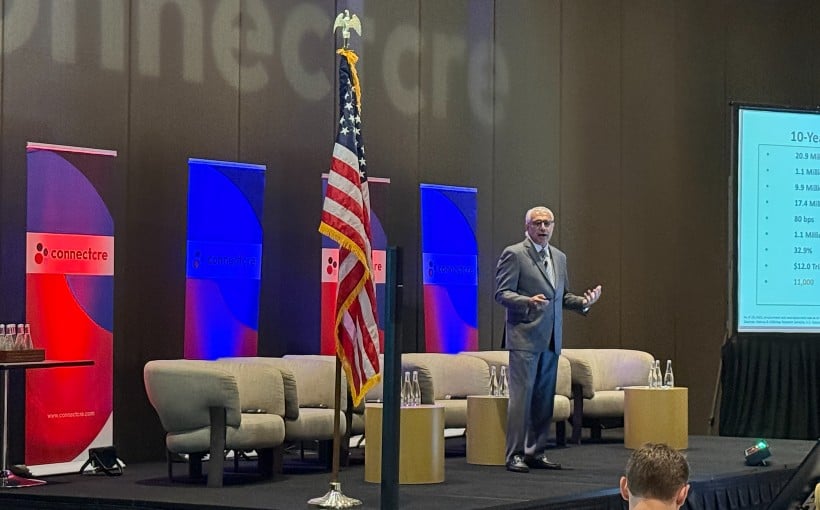
Speaking at Connect Apartments 2025 in Los Angeles, Hessam Nadji, CEO of Marcus & Millichap, stated that the commercial real estate sector—particularly apartments—is poised to receive a significant influx of institutional capital in the coming years.
“We’re just at the beginning of a major wave of capital moving toward commercial real estate, and apartments in particular,” Nadji told attendees. “Institutions today only have about 11% of their total assets allocated to commercial real estate. Pension funds, which manage $38 trillion, have just 4% of that allocated to commercial real estate.”
Nadji delivered his insights during the opening session titled *CRE Investment Strategies for 2026 & Beyond*, where he highlighted the resilience of the multifamily sector even through market fluctuations. With the effects of the pandemic receding, he noted that “even the office market is recovering,” while multifamily has remained relatively steady. Additionally, he emphasized the growing investor enthusiasm for retail, now considered “the new darling of the industry,” and a major focal point for future capital flow.
He pointed to the immense untapped potential within the private investor segment—specifically, the 39 million U.S. households with a net worth of $500,000 or more, 81% of whom are not yet invested in commercial real estate beyond their primary residence.
“Think about the education we can bring to that private network of capital,” Nadji said. “Investing into commercial real estate, particularly apartments, presents a massive opportunity.”
Focusing on Southern California, Nadji explained that the region’s supply-demand dynamics in the multifamily sector remain favorable. Currently, there are 20,000 apartment units in the delivery pipeline for the region—a modest figure when compared to other U.S. metros, some of which have even higher construction volumes.
Still, Nadji acknowledged existing concerns about valuations. “The spread between interest rates and cap rates has compressed to the lowest level since 2005 due to interest rate spikes,” he noted. “Cap rates have been adjusting upward, and I believe we’ve seen the worst of this disconnect between rates and cap rates.”
Southern California markets have seen relatively moderate cap rate increases, with Los Angeles, Orange County, and San Diego each experiencing a 70 basis point rise, and the Inland Empire seeing a 50 basis point uptick—compared to 110 basis points nationally.
“I would consider Southern California and the Bay Area two diamonds in the rough in the greater scheme of where you can get true value going into the next five years,” Nadji concluded, “especially when compared with many other growth markets that have not seen as much fluctuation in pricing and cap rates.”
The event was held at the Fairmont Century Plaza, drawing investors, brokers, and industry leaders from all over the country for a forward-looking discussion on trends shaping commercial real estate.