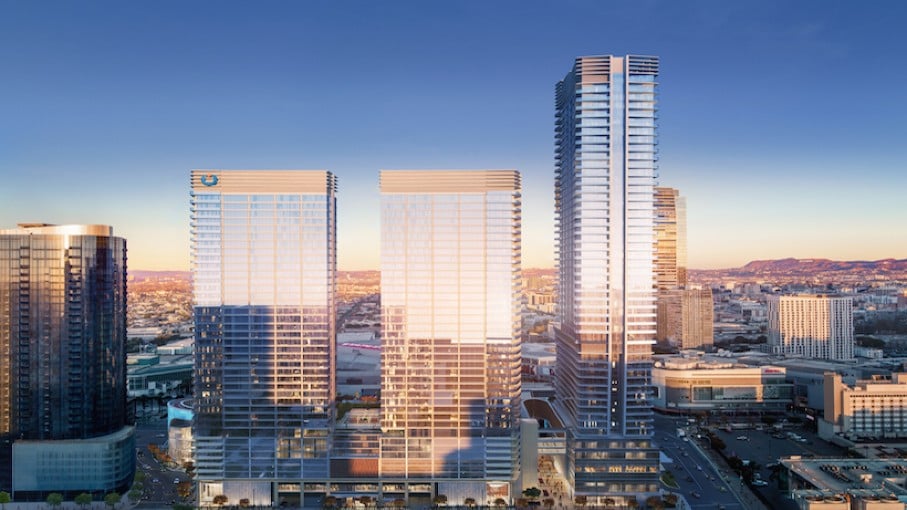
Los Angeles city officials and the prospective buyers of Oceanwide Plaza have marked a visible turning point for the long-stalled mixed-use complex, highlighting the near-complete removal of extensive graffiti that had covered much of the unfinished towers. According to the Los Angeles Times, the clean-up was a central requirement imposed by the city on KPC Group and Lendlease as a condition of their expected acquisition of the property through a bankruptcy sale scheduled to close in January.
The graffiti had climbed to the upper floors of the incomplete high-rises, turning the property into an unintended landmark on the Los Angeles skyline. By tying the removal work directly to the sale process, city officials sought to address both the project’s appearance and its broader impact on the surrounding area. The buyers complied with the condition, and officials joined them on Thursday to recognize the progress as crews near completion of the cleanup.
John Petty of KPC Group described the moment to the Los Angeles Times as a turning point for the property, characterizing it as a shift from a blighted phase toward renewed activity. He indicated that construction to complete the development is expected to begin soon after the transaction closes. Petty further stated that the three-tower complex is planned to be finished according to its original design, which calls for 504 residential units, a luxury hotel component and a shopping center.
Oceanwide Plaza was initially advanced by Beijing-based Oceanwide Holdings, which is identified as the project’s original developer. The company invested about $1,200,000,000 into the development before running out of capital in 2019, at which point construction stopped with the complex reported to be roughly 60% complete. The halted state left large portions of the structure exposed and unfinished for several years.
Petty told the Los Angeles Times that it is expected to require an additional $850,000,000 to finish the project. That figure underscores the scale of investment necessary to bring the mixed-use scheme to completion after years of inactivity. While detailed financing terms were not disclosed in the report, the combination of past spending and remaining cost illustrates the magnitude of capital tied up in the site.
In the years following the construction stoppage, graffiti artists began using the towers as a large-scale canvas, making the structure a highly visible symbol of delay. Some downtown stakeholders viewed the resulting display as an embarrassment and an eyesore for the area, the Los Angeles Times reported. With the graffiti now being removed and a bankruptcy sale approaching closing, local officials and the buyers are signaling a potential path forward for repositioning the unfinished complex as an active mixed-use destination.