**Capital Markets and Industrial Lending: Q&A with Byline Bank’s Matt Robertson**
_While industrial has long been a compelling asset class, owners, developers, and investors are facing increasing challenges in raising capital. To shed light on evolving industrial trends and capital market shifts, ConnectCRE spoke with Matt Robertson, Senior Vice President and Team Lead at Byline Bank._

*Matt Robertson*
**ConnectCRE:** What trends are you seeing in the national industrial commercial real estate market, and how are they shaping deal structures and underwriting standards?
**Matt Robertson:** We’re seeing a clear flight to quality—both from a sponsorship and deal perspective. All lending sources are aggressively pursuing top-tier market deals. Regional banks, which have traditionally focused on value-add or construction loans, are now competing for stabilized opportunities because they are seeking safer and more profitable loans in a highly competitive lending environment.
The rise of private credit and the recent compression in credit spreads across all lending sources have further intensified competition. This has led to more aggressive loan terms and structures.
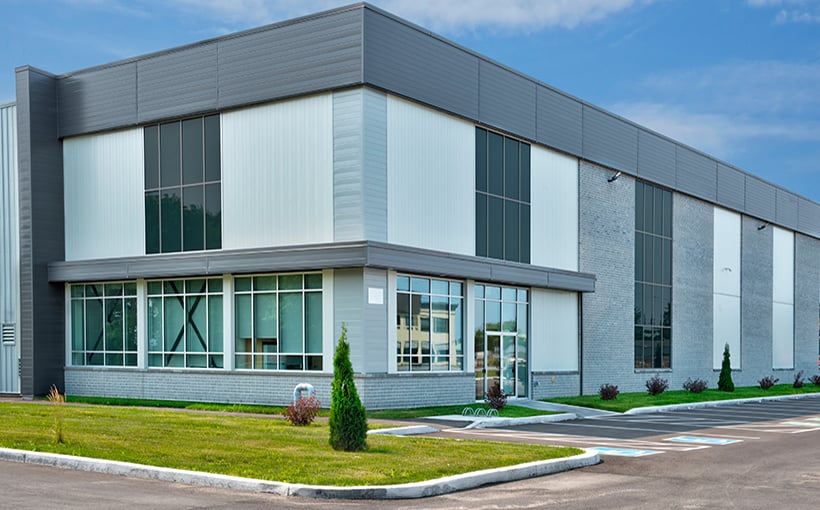
Another noticeable trend is the shift toward smaller buildings—commonly referred to as “small bay” industrial properties. Typically under 100,000 square feet, these assets are popping up in both newly developed industrial parks and infill locations where older buildings are being replaced.
**ConnectCRE:** Why is there a move toward the smaller bay building type?
**Matt Robertson:** Smaller buildings are faster and less expensive to develop, which improves speed to market—key in mitigating risks tied to economic uncertainty. Additionally, these properties tend to have lower vacancy rates thanks to their wider base of potential tenants, making them attractive from both a lending and investment standpoint.
Contrast that with large bulk properties, which are significantly more costly in today’s high-construction-cost environment. These larger developments often require land assemblage or complex zoning approvals, which increase execution risk due to long lead times.
**ConnectCRE:** What do you consider to be some of the most critical elements of a successful industrial deal from a lending standpoint?
**Matt Robertson:** First and foremost, sponsorship experience is vital. From the property side, thoughtful design and layout are key—features like electrification, proper clear heights, ample dock positions, and expanded truck parking all matter. Future-proofing through flexibility in design to accommodate both single-user and multi-tenant configurations also adds value.
Location remains one of the most important components. At this point in the market cycle, lenders are seeking “no-brainer” locations—markets with high barriers to entry and consistently strong demand.
**ConnectCRE:** How have interest rate volatility and inflationary pressures changed the kinds of industrial deals your team is seeing, particularly in the middle market?
**Matt Robertson:** While the types of deals haven’t necessarily changed, we are seeing a larger equity requirement in the capital stack. As project costs increase, a bigger equity cushion is necessary to maintain lender protection, especially given today’s higher interest rate environment.
**ConnectCRE:** Have you noticed any emerging trends worth keeping an eye on?
**Matt Robertson:** One increasingly common development is the rise in user sales—where businesses purchase their own properties rather than continue leasing. This allows them to control costs and avoid rent hikes.
Another area gaining traction is industrial outdoor storage (IOS). Previously a fragmented, user-owned niche, IOS is becoming more institutionalized. Over the last 18 to 24 months, we’ve financed roughly $150 million to $200 million in IOS properties. It’s definitely a sector to watch moving forward.