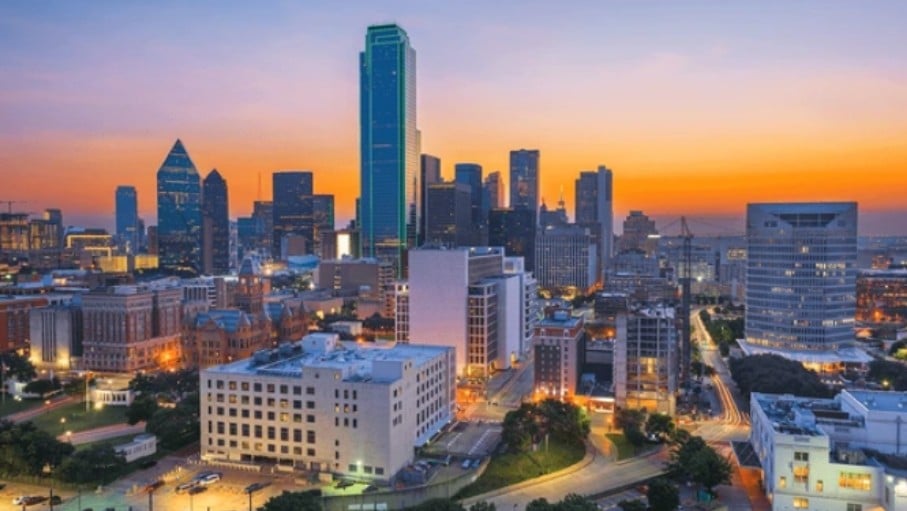
The Dallas-Fort Worth office market posted improving fundamentals through the third quarter of 2026, with vacancy moving lower and investment activity gaining momentum. According to Yardi Matrix data cited in the report, the Metroplex registered a decline in office vacancy over the 12 months ending in September 2026, even as the market continued to support one of the largest development pipelines in the country.
Dallas’ competitive office pipeline ranked as the second-largest among U.S. metros, reflecting an elevated level of ongoing construction. Starts on new office projects increased compared to 2025, underscoring that development activity has not materially slowed despite shifting conditions in the broader office sector. This combination of falling vacancy and rising construction points to sustained demand for space in select parts of the market.
On the capital markets side, Dallas’ office investment volume reached $3.7 billion on a year-to-date basis through the end of September 2026. That level of trading activity placed the market third among the top 25 U.S. metros, highlighting the Metroplex as one of the more liquid office markets nationally. Within its defined peer group, Dallas was second in terms of investment volume, trailing only the Bay Area.
The Metroplex’s performance was framed against several large U.S. office markets. The Bay Area registered $4.6 billion in office investment volume over the same period, ahead of Dallas. However, Dallas outpaced Houston, which recorded $2.1 billion, as well as Austin at $1.6 billion and Phoenix at $1.2 billion, among other peers. This relative outperformance underscores that investors continued to allocate capital to Dallas-Fort Worth office assets in 2026.
Development fundamentals remain active as well. At the end of September 2026, the Dallas-Fort Worth office development pipeline encompassed 3.6 million square feet of space across 23 projects. Within its peer set, the Metroplex held the lead position for office construction activity. Houston followed with 2 million square feet underway, while the Bay Area reported 1.7 million square feet under construction.
In terms of space utilization, Dallas’ office vacancy rate declined by 360 basis points over the prior 12 months, signaling some absorption of space during a period when many U.S. office markets have faced demand headwinds. Taken together, the drop in vacancy, strong investment volumes and robust development pipeline position Dallas-Fort Worth as a relatively active and resilient office market heading into late 2026.