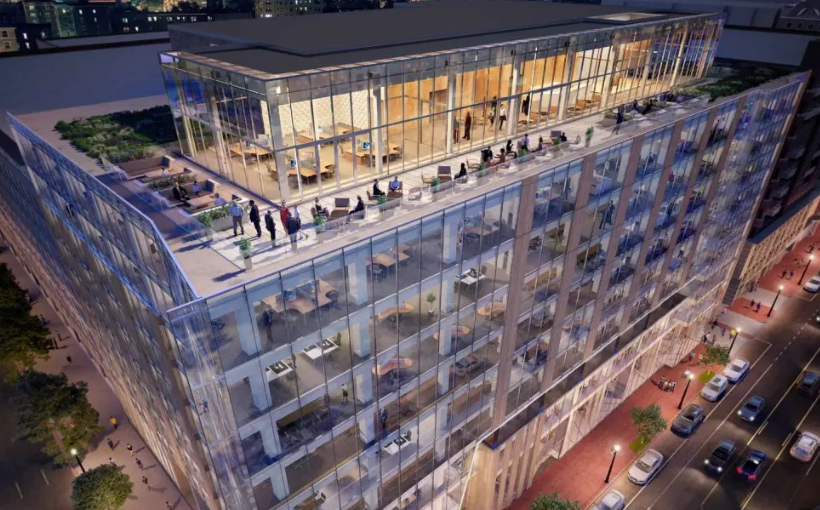
The D.C. Council has approved up to $275 million in bond financing to support the conversion of a Penn Quarter office building into a mixed-use residential project featuring a Sprouts Farmers Market on the ground floor. The plan calls for the 1970s-era office property at 600 E St. NW, formerly anchored by the U.S. Department of Justice, to be redeveloped into a 415-unit apartment building.
The bond proceeds will be directed to the nonprofit Madrone Community Development Foundation. According to the Washington Business Journal, Madrone is expected to use the funds to support acquisition, demolition, renovation, and tenant improvement work tied to the project, including the build-out of the planned Sprouts store. Madrone is expected to repay the financing provided by the District.
Project documents outline specific allocations of the bond financing across key stages of the conversion. Approximately $44 million is earmarked for acquisition costs, $13 million for demolition, $81 million for renovation, and $6 million for improvement work associated with the roughly 25,000-square-foot Sprouts Farmers Market space on the ground floor. These allocations underscore the capital-intensive nature of repositioning an older office asset into multifamily use with a grocery component.
The existing office building is currently owned by S.C. Herman & Associates Inc. The property dates to the 1970s and previously served as a significant federal office location. The Department of Justice, described as a longtime anchor tenant, has since vacated the building. The federal agency shed more than 1 million square feet of space across four buildings and relocated nearly 840,000 square feet to Three and Four Constitution Square, opening the door for a full-scale repositioning of the Penn Quarter asset.
The redevelopment will introduce hundreds of new apartment units to Penn Quarter while adding a new grocery option in the form of Sprouts Farmers Market. The dedicated 25,000-square-foot ground-floor space for Sprouts represents a substantial retail commitment within the project, pairing residential density with a neighborhood-serving retailer as the property transitions away from legacy office use.