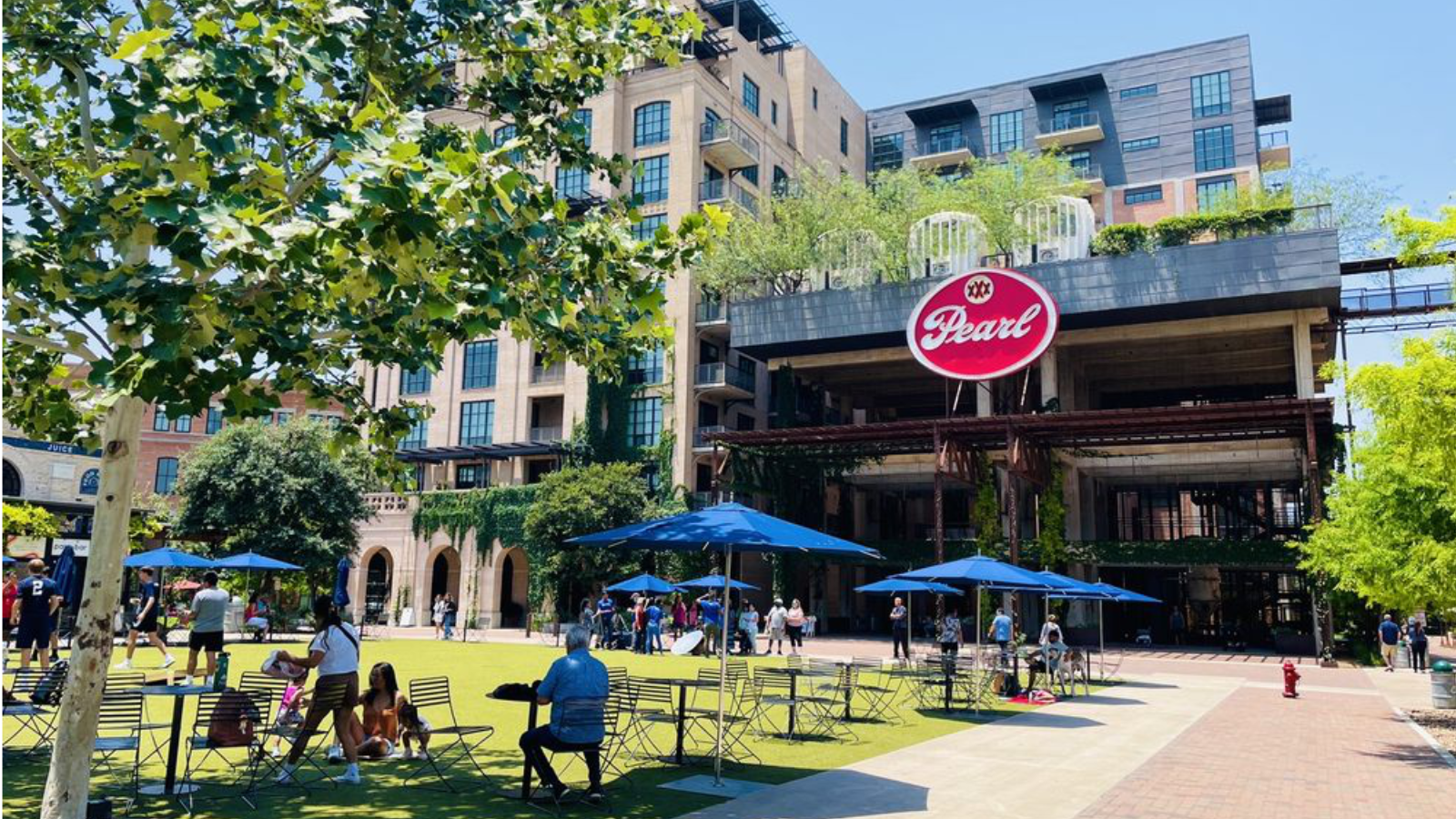
Oxbow Development Group has submitted plans to the city for a significant expansion of the Pearl Brewery Redevelopment, proposing 10 new retail buildings positioned on both sides of Avenue A. The submittal includes both ground-up construction and a request to demolish a vacant industrial building at 250 E. Grayson St., making way for additional retail space within the established mixed-use environment.
The planned buildings will contribute 85,000 square feet of new space to the broader Pearl complex. The expansion is being advanced through a partnership between Oxbow Development Group and 3-O Real Estate Partners, which are jointly leading the effort to grow the retail footprint at Pearl. The joint venture is pursuing a tenant roster that spans local, regional, national, and global retailers, with the stated goal of aligning new occupants with the character and positioning of the Pearl destination.
Design responsibilities for the project have been awarded to two architectural firms, Alamo Architects and Don B. McDonald Architects. Their work will shape the next phase of Pearl’s built environment, integrating the new retail buildings into a site that has already undergone extensive transformation. The development team is planning to start construction in early 2027, with completion targeted for late 2028, establishing a clear delivery window for the additional retail inventory.
The Pearl Brewery Redevelopment is described as a transformational adaptive reuse of a 21-acre brewery dating from the early 1900s into a contemporary mixed-use village. Within this context, the new retail buildings represent the latest phase of an ongoing repositioning of historic industrial space into an active commercial and community hub. By adding modern retail structures while also removing obsolete industrial improvements, the project continues to evolve the site from single-use manufacturing to a diversified, multi-tenant environment.
As envisioned, the expansion supports the broader retail and mixed-use strategy at Pearl by introducing additional leasable area that can support a wide range of tenant profiles. The focus on different scales of retailers, from local concepts to global brands, indicates an effort to maintain Pearl’s established identity while accommodating sustained interest from a diversified tenant base. The combination of new construction, demolition of a vacant building, and the adaptive reuse framework underscores Pearl’s role as a long-term redevelopment initiative centered on retail and mixed-use activity.