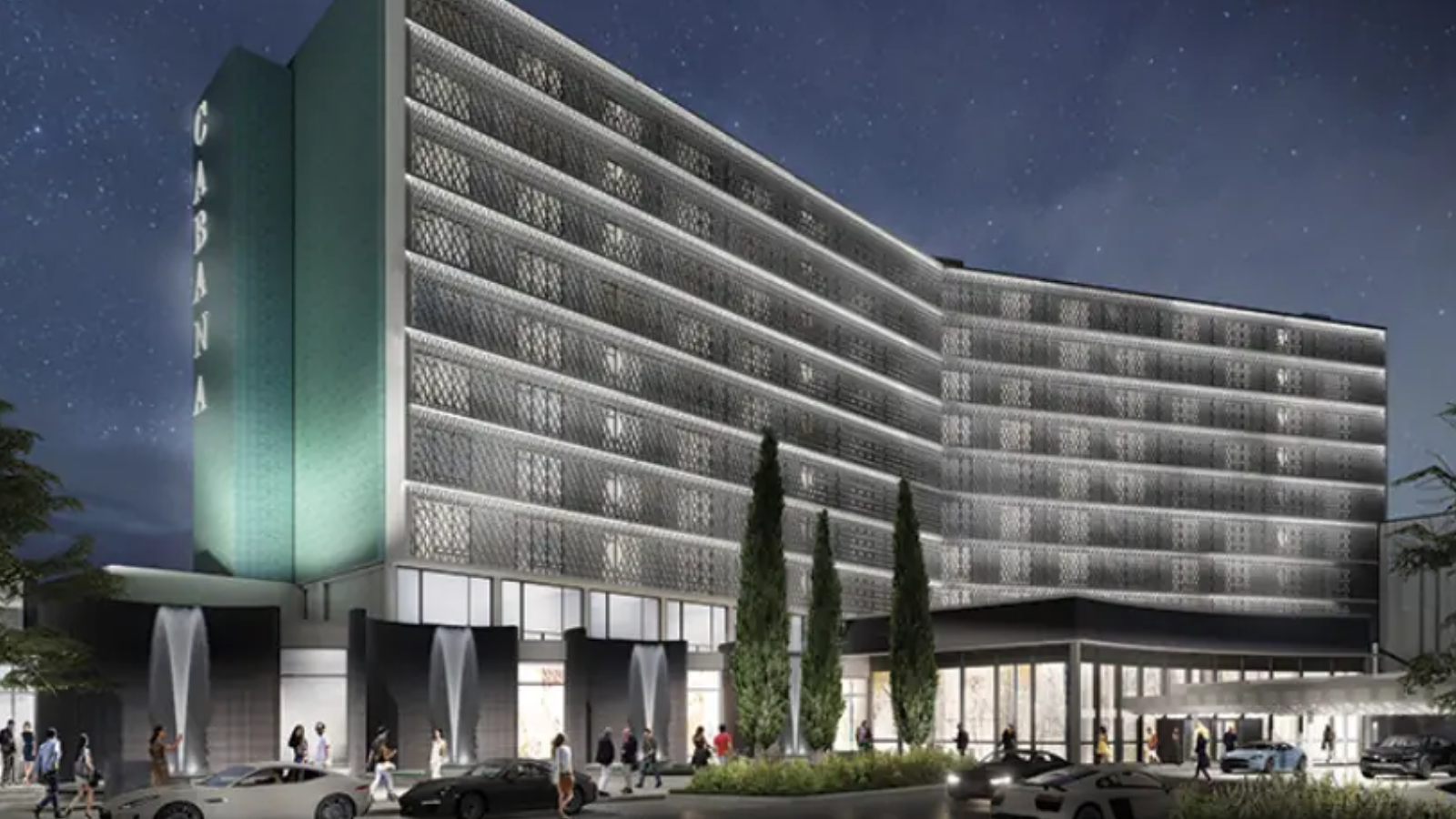
A former celebrity-favorite hotel along Dallas’s Stemmons Freeway is in the midst of a major residential transformation. The Cabana Motor Hotel, which once hosted acts like the Beatles and the Monkees and counted Raquel Welch among its cocktail lounge staff, is being converted into a multifamily community.
Opened in 1963, the mid-century modern property has passed through multiple hands over the decades, including a stint under the county jail system. Its latest chapter began after Sycamore Development acquired the asset in 2023 and moved forward with a full-scale redevelopment. The existing structure was completely gutted as part of the effort to convert former guest rooms into rental housing.
Sycamore Development is reconfiguring the building into a 175-unit apartment complex. While the interiors have been stripped back to accommodate residential layouts, the firm has focused on retaining and reintroducing notable design elements from the property’s heyday. According to reporting from the Dallas Business Journal, the redevelopment plan calls for restoring aspects of the building’s historic lighting system and reinstalling a portion of the original signage that once defined the hotel’s presence along the freeway.
The redevelopment team has also restored much of the original pool and surrounding pool deck, preserving a key feature of the property’s resort-style past. The Cabana is listed in the National Register of Historic Places as an example of mid-century modern architectural design, adding a preservation dimension to the adaptive reuse effort. The combination of historic status and residential conversion positions the project at the intersection of heritage conservation and contemporary housing demand.
The conversion represents a $70 million investment. As construction advances, Sycamore Development is preparing to bring the project to market, with pre-leasing expected to begin this month. Leasing activity will provide an early read on renter demand for units in a redeveloped, historically significant hospitality asset along a major Dallas corridor.
The property’s evolution from a vintage motor hotel to a modern apartment community illustrates how aging hospitality assets can be repositioned to extend their useful life while contributing new housing stock. The integration of restored architectural elements, signage, and amenity spaces such as the pool area reflects an effort to balance contemporary residential use with the site’s mid-century roots.