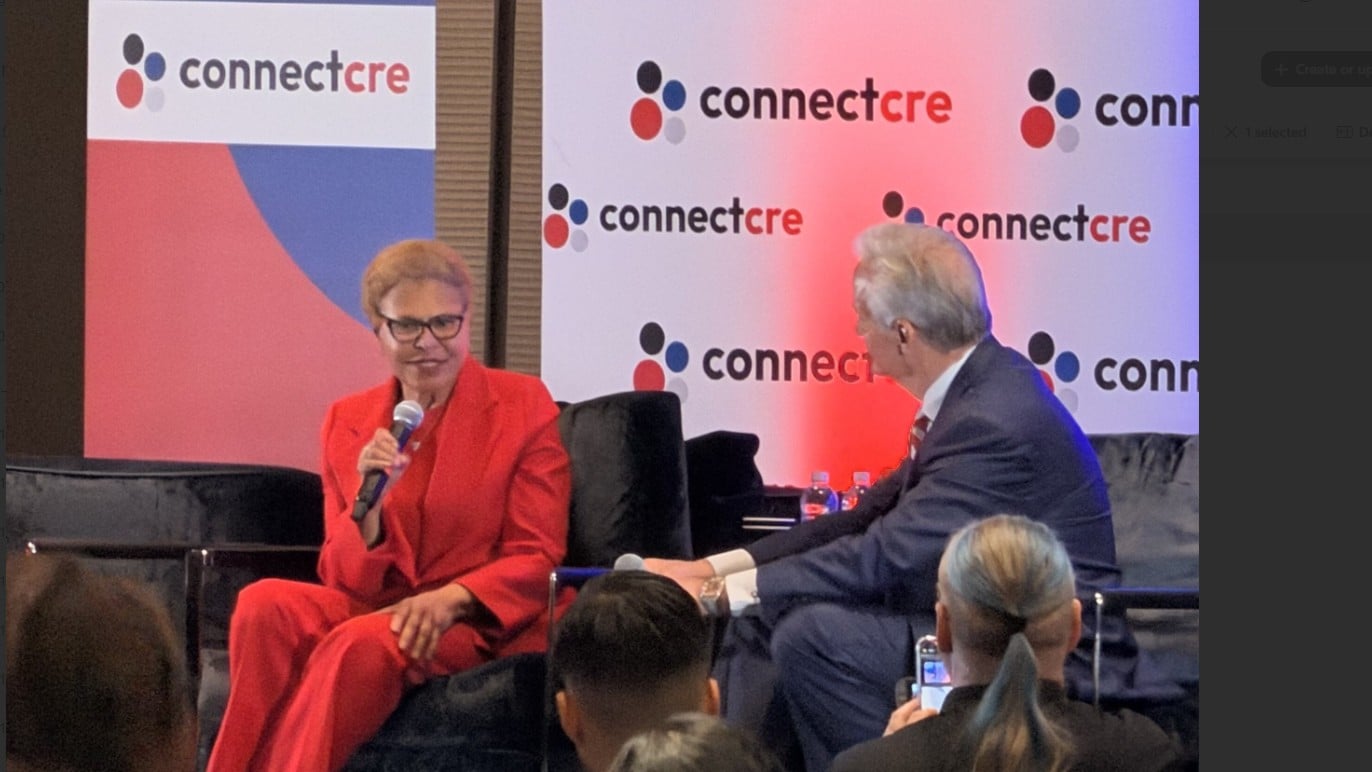
Los Angeles Mayor Karen Bass used a recent on-stage conversation with CBRE executive Lew Horne at Connect CRE Los Angeles 2026 to outline how her administration is trying to address affordability and development challenges that were prominent during her election campaign three-and-a-half years ago. She said concerns about crime, homelessness and the difficulty of getting projects entitled and built in the city were closely linked and needed to be tackled together.
Bass noted that early in her term she moved to speed up housing development, especially on the affordable side. She pointed to a pipeline of 42,000 units that have been fast-tracked under Executive Directive 1 (ED1), with 6,000 of those units currently under construction. The administration views this accelerated pipeline as one way to expand supply more quickly in a market where both rents and construction costs have been persistent pressure points.
A key component of the mayor’s strategy has been to broaden the city’s adaptive reuse framework. Bass said adaptive reuse is no longer confined to a single area of Los Angeles but has been expanded as a citywide program. The goal is to make it easier for property owners and developers to convert underutilized buildings into housing across multiple neighborhoods.
Using Koreatown as an example, Bass described how some existing office towers are being converted into residential use, even though those changes are not evident from the street. She recalled that only a few years ago, the conventional wisdom was that converting office properties into housing in Los Angeles was too complex. According to Bass, several developers have now worked out how to execute these transitions, and she believes this change in approach will be one of the keys to helping revitalize downtown.
Horne, who serves as president for Greater LA, Orange County and Inland Empire at CBRE, reflected on what he termed overlapping crises facing the city when Bass was campaigning. When asked what needed to change at City Hall to gain traction, Bass cited the importance of confronting institutional culture, which for her meant being willing to be disruptive and to change leadership at the general manager level where necessary.
Despite the progress she highlighted, Bass said the city still has significant work ahead to streamline its development processes. She described a fragmented system in which developers must navigate 12 different city departments, often receiving conflicting direction before ultimately facing potential delays from the Department of Water and Power late in the process. Bass argued that these functions need to be reorganized and centralized to create a more predictable path for projects and to support continued momentum in Los Angeles’ housing production and adaptive reuse initiatives.