
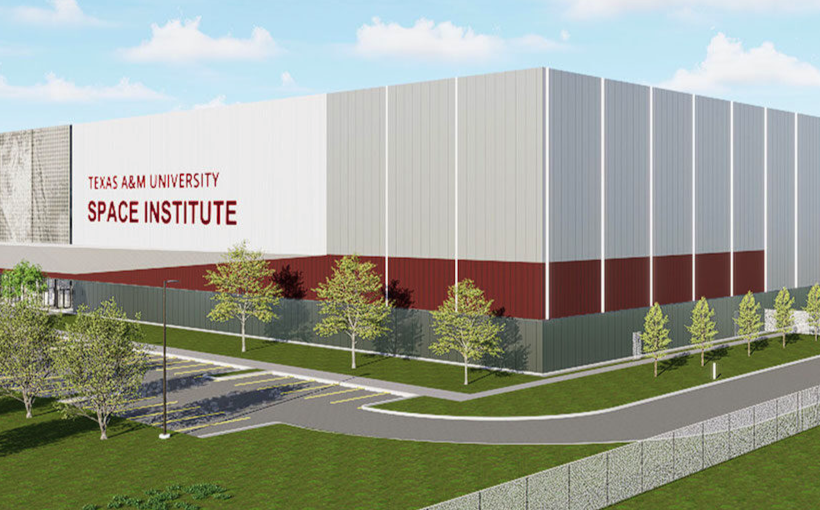
Vaughn Construction has reached a key construction milestone at the Texas A&M University Space Institute, located within NASA’s Johnson Space Center Exploration Park. The project has officially topped out, signaling the completion of the primary structural work and allowing teams to turn their focus to interior build-out and specialized testing environments.
The facility is planned to span 400,000 square feet and is designed to support a broad range of space-related activities. A central feature of the project is the creation of 234,000 square feet of Mars and Moon landscapes, described as roughly the size of two football fields. These indoor Moonscape and Marscape environments are intended to provide controlled conditions for testing, training, and workforce development tied to future space exploration missions.
With the main structure now in place, construction activity is shifting into these large-scale interior simulation areas. The specialized landscapes are positioned as core program elements, enabling hands-on work with equipment, procedures, and personnel preparation in settings that replicate extraterrestrial terrain.
According to reporting from the Houston Business Journal, the building is targeted for substantial completion by November of this year. That schedule would move the project from structural delivery into late-stage construction and fit-out over the coming months, positioning the Space Institute to begin preparing for occupancy and operations once construction is finished.
The Space Institute is backed by $200 million in state funding that was approved by the Texas Legislature in 2023. This capital commitment underscores a policy focus on supporting space-related research, training, and technology development, and anchors the project within a broader state-led initiative to expand activity in the sector.
Several tenants have already confirmed plans to move into the building, according to the source material. Some of these users have received grants from the Texas Space Commission specifically related to their occupancy of the facility. Those grants appear to be aligned with the mission of the Space Institute, supporting organizations that will use the building for testing, training, or other activities connected to space exploration.
As construction advances toward the planned substantial completion date, the combination of state funding, early tenant commitments, and mission-specific interior environments positions the Texas A&M University Space Institute as a dedicated hub for space-focused education, research, and workforce development within NASA’s Exploration Park.