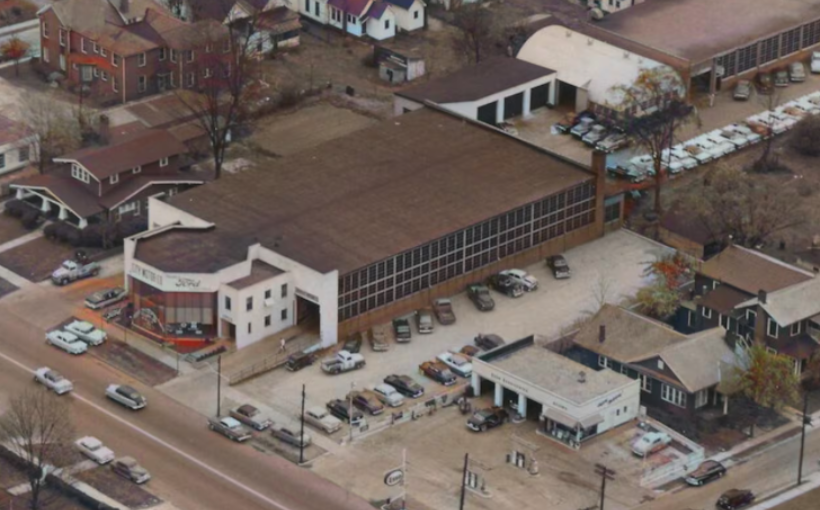
A shuttered Ford automobile dealership in Salisbury, North Carolina is being converted into a new senior housing community, reflecting an adaptive reuse of older commercial space for residential needs. The property at 419 Main Street will be transformed into Ford City Motor Senior Housing, a 55-plus community designed to provide age-restricted rental housing in a multi-building configuration.
The development plan calls for apartments to be distributed across five buildings on the site. A key architectural feature of the project will be a central hallway lined with residential units on both sides, leading into the former Ford dealership showroom. That former showroom area is being repurposed as a community space for residents, retaining its large glass-panel windows to provide natural light and a connection to the building’s historic character.
The original historic dealership structure is slated to contain 28 residential units. A newly constructed expansion will add another 36 units, bringing the total to 64 apartments within the complex. The project is described as multi-generational living space, while also being specifically planned as a 55-plus community, indicating a focus on older adults while accommodating a range of unit types and household configurations.
Rents at Ford City Motor Senior Housing are expected to vary by unit type. Efficiency apartments are planned to start at $800 per month, while two-bedroom units are projected to lease for up to $1,050 per month. These stated rent levels position the community within an attainable price range for many seniors, though no additional details on income restrictions or subsidy structures were provided.
The Osceola Council on Aging (OCOA) is identified as the development leader for the project. OCOA is being joined in the effort by HUD North Carolina, the U.S. Department of Housing and Urban Development, and the North Carolina Housing Finance Agency. Together, these government and nonprofit entities are collaborating to reposition the former auto dealership into a dedicated senior housing complex, leveraging the existing building while adding new construction to increase the residential capacity on site.
No timeline for completion, total development cost, or specific financing structure has been disclosed, but the project illustrates how older commercial assets can be converted to meet growing demand for senior housing in smaller metro markets.