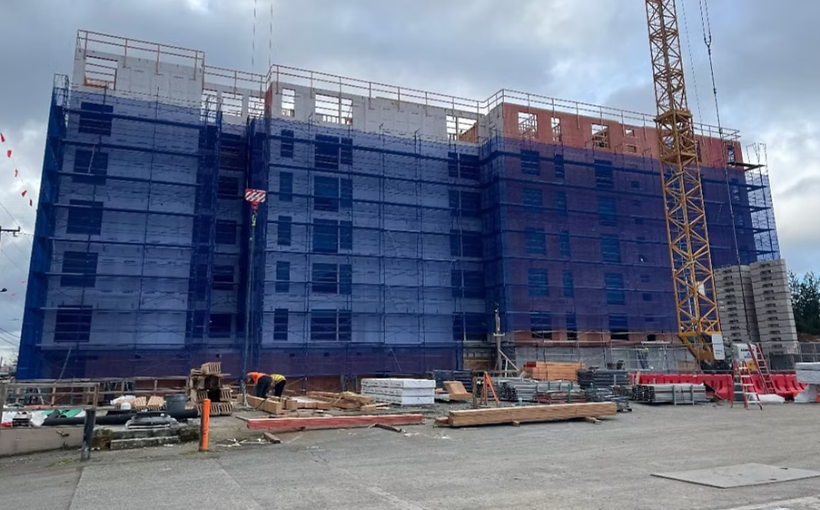
The Low Income Housing Institute (LIHI) has reached the topping-out milestone for its 125th Senior Housing development in North Seattle. The seven-story building, located at 12245 Aurora Ave. N., is planned as a dedicated senior housing community and marks a key point in construction progress for the nonprofit’s latest affordable housing initiative.
The project will deliver 89 residential units in a building totaling 67,345 square feet, on a site measuring 16,674 square feet. The scale of the property positions it as a material addition to the local affordable senior housing inventory, with the unit count fully supported by a layered capital stack that combines federal, state, local, and private funding sources.
LIHI secured a HUD 202 Senior Housing award for the project, which includes $3.3 million designated for construction and operating subsidies for the 89 units. This HUD allocation is specifically structured to support both the initial delivery of the homes and the longer-term affordability of the property, reflecting a federal commitment to income-restricted senior housing.
The City of Seattle is contributing $9.9 million to the development, providing substantial local public capital to advance the project. Complementing that support, the State Housing Trust Fund is contributing $5 million for construction. Together, these commitments underscore a coordinated public-sector role in funding senior affordable housing in the city.
The project also received an allocation of 9% Low-Income Housing Tax Credits from the Washington State Housing Finance Commission. These tax credits are a core element of the capital stack, enabling the syndication of equity to help finance development costs. In addition, the project has secured a $3 million award from HUD sponsored by Senator Patty Murray, further expanding the federal support behind the initiative.
Rounding out the public and quasi-public funding, the Federal Home Loan Bank of Des Moines is providing an additional $3 million. This contribution adds another institutional capital source to the financing structure and reinforces the multi-layered nature of the project’s funding.
On the private capital side, KeyBank is providing construction financing as well as equity through the Low-Income Housing Tax Credit program. This role places KeyBank at the center of both the debt and LIHTC equity components of the deal, aligning conventional bank lending with mission-driven affordable housing investment.
Runberg Architecture Group is serving as the project architect, bringing design oversight to the seven-story senior housing building. Marpac Construction is the general contractor, responsible for execution of the construction program through and beyond the topping-out phase. Together with LIHI, these firms are advancing a senior housing development that is supported by a diversified mix of federal, state, local, and private capital sources.