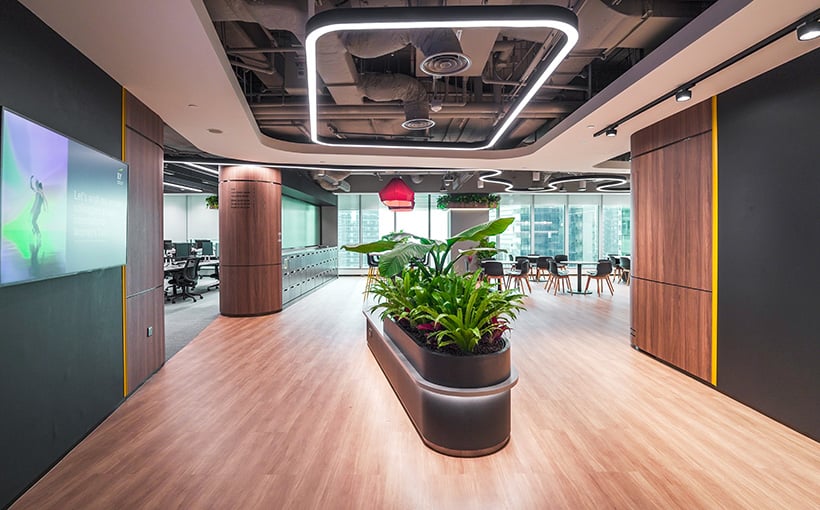
Commercial office interiors have evolved markedly since the era of cube farms and formal executive suites, with today's workplace strategies centering on flexibility, collaboration and employee experience. JLL's newly released Global Design Perspectives 2026 report highlights how corporate real estate decision-makers are rethinking interior design to futureproof assets against rapid technological and organizational change.
Emma Luyt, Americas Head of Workplace Design and Global Design Delivery Lead for Project and Development Services at JLL, told Connect CRE that the research uncovered a return to fundamentals. She noted two main priorities: building in flexibility and adaptability to respond to fast-changing conditions, and designing spaces that reinforce human connection and collective intelligence.
The report points to ever-evolving technologies, including AI, as a key driver behind futureproofing initiatives. Examples include reconfigurable zonal layouts supported by mobile panels and modular pod systems that can be shifted or combined to accommodate varying collaboration needs over time. Long-term adaptability is framed as more important than short-term fixes, with customizable lighting and flooring systems cited as tools to make reconfiguration easier while preserving a sense of permanence.
Luyt cited Ernst & Young's 145,000-square-foot Singapore office as an example of a future-fit workplace. The firm transformed the space following an assessment of employee work styles and organizational preferences, with flexible workstations serving as a core feature of the redesign.
The report also underscores a growing emphasis on tactile and acoustic design elements intended to support focus and performance while delivering aesthetic and environmental comfort. This connects to the expanding role of neuro-design, which Luyt said has existed as a concept and research field for some time but has gained momentum as technology and analytics have made it more actionable.
Neuro-design focuses on how people respond to different environments and applies those insights through data-driven and parametric design methods. Luyt referenced JLL's Work Science research, which uses portable EEG devices to measure cognitive responses to real-world work settings, as an example of how neuroscientific tools are being integrated into workplace strategy.
Another major theme in the report is user control and personalization. According to Luyt, contemporary workplace strategies increasingly aim to give occupants more control over their individual experience of a space. This is particularly relevant in offices with higher levels of unassigned seating, where creating a sense of choice and 'place' can be critical for employee engagement.
Practical applications range from smart systems that allow users to adjust lighting and temperature to customizable design elements that can be tailored to team activities. Shared amenities and activity-based working are also described as part of this personalization trend, contributing to workplaces that can adapt alongside business needs and workforce expectations.